Educational overview only. Prudent Guardian (inspirecodingedu.com) is not an insurance company, broker, law firm, or registered investment adviser, and does not provide personalized insurance, investment, tax, medical, or legal advice. Verify details with licensed professionals and official issuers.
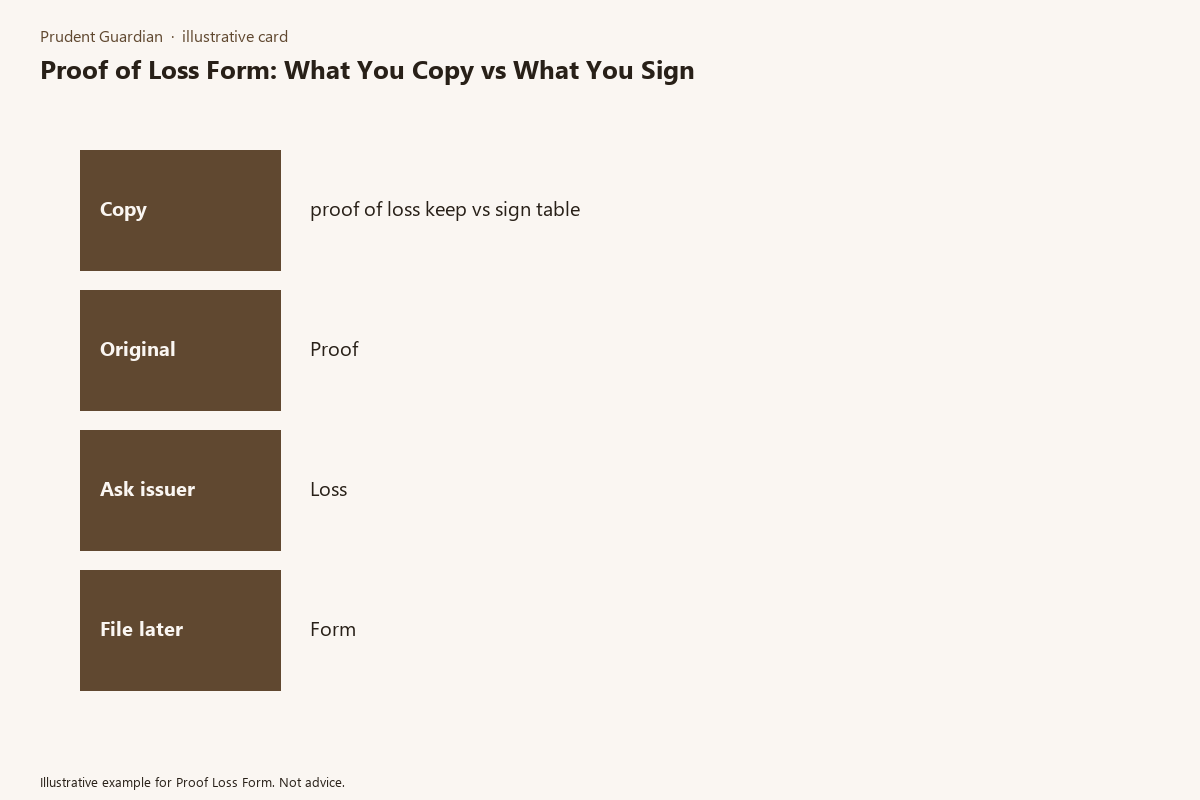
This keep-vs-sign reference table breaks down designated sections of a standard proof of loss form you can save copies of for personal files and which portions require your legal signature for formal insurance submission. Proof of loss forms are sworn statements required by most property, casualty, and some health insurance carriers to validate the value of damages or losses you report after a covered incident. Incorrectly signed sections, missing copies, or missed submission deadlines can lead to avoidable claim delays or denials. This educational resource from Prudent Guardian is designed to standardize your personal record-keeping, and does not bind coverage, adjust claim outcomes, or constitute legal or claims advice; always confirm form requirements directly with your issuing insurance carrier or licensed claims professional.
Proof of loss form sections requiring official signature
The table below outlines standard sections for most state-regulated proof of loss forms, so you can quickly identify which portions require your signature and which you only need to retain copies of for your records. Always confirm section requirements with your specific carrier, as form structure may vary slightly by policy type and state.
| Section Name | Requirement | Notes for Submission |
|---|---|---|
| Sworn Statement of Loss Value | Sign + Keep Full Copy | This is the legally binding affirmation that all loss values you report are accurate to the best of your knowledge. Falsification of values may lead to claim denial or fraud allegations, so only sign if all line items match your supporting documentation. |
| Notary Public Acknowledgment | Sign + Keep Full Copy | Only required if your carrier explicitly requests a notarized form. You must only sign this section in the presence of a commissioned notary public, who will also sign and stamp the form to validate your identity. |
| Carrier Claim Number Identification Block | Keep Copy Only | No signature required from you. This section is pre-filled by your carrier or added by your adjuster to route the form to the correct claims processing queue. |
| Itemized Damages Schedule | Sign + Keep Full Copy | Cross-reference every line item with attached receipts, photos, repair estimates, or medical billing statements before signing. Cross out empty fields with a single line and write “N/A” to prevent unauthorized additions after submission. |
| Authorization for Records Release | Sign + Keep Full Copy | This grant of permission allows your carrier to pull relevant records (e.g., property tax assessments, previous repair receipts, medical billing history) to verify your claim. Only sign if you have reviewed and agreed to the explicit scope of records requested. |
| Third-Party Damage Addendum | Keep Copy Only + Sign If Applicable | No signature required unless you are filing for damage to a third party’s property or injuries to a non-household member. If applicable, sign only after confirming all reported third-party damages are accurate. |
| Carrier Receipt Acceptance Block | Keep Copy Only | This section is reserved for signature by a licensed carrier representative when they receive your completed form. You do not sign this portion at any point. |
Before signing any section of the form, review the entire document line by line to ensure no pre-filled information is incorrect, and no blank fields are left unmarked. Never sign a partially completed or blank proof of loss form, as this leaves you vulnerable to unauthorized changes to your reported damages or loss value after submission. If you are unsure whether a section requires your signature, reach out to your assigned claims adjuster for written confirmation before proceeding.
Printed physical folder for retained proof of loss copies
Use a dedicated, heavy-duty physical folder for each separate insurance claim, never commingling proof of loss forms or supporting documents from different incidents. Label the front of the folder with your full name, carrier name, claim number, date of loss, and date of form submission to enable quick retrieval if requested by your adjuster or legal representative. Store the full signed copy of your proof of loss form, all attached supporting documents (receipts, photos, estimates, billing statements), and a copy of your carrier’s confirmation of receipt in this folder. Keep the folder in a locked file cabinet or fireproof home safe, rather than relying solely on digital cloud storage, as physical copies are often accepted as valid evidence in the event of a dispute over form contents. Illustrative example: For a claim filed after a 2024 pipe burst that caused $8,500 in basement water damage, your folder would include the signed proof of loss form, 15 timestamped photos of the damage pre and post-repair, a copy of the plumber’s repair invoice, and a copy of your property insurance declaration page.
Submission confirmation letter for filed proof of loss forms
Whenever you submit a completed proof of loss form, regardless of submission method (certified mail, email, in-person delivery, carrier online portal), request a written confirmation of receipt that includes three specific details: the exact date the carrier received the form, the full name and employee ID number of the carrier representative who processed the receipt, and an explicit note that all required attachments were included in the submission. If you submit via certified U.S. mail, keep the green return receipt stub and attach it to your confirmation letter before filing it in your printed folder. If you submit via email, save a read receipt, a PDF copy of the sent email including all attachments, and a written response from your adjuster confirming receipt within 3 business days of submission. This confirmation is critical if your carrier claims they never received your form, or if you need to prove you met the required submission deadline to avoid claim denial. Save a digital copy of the confirmation in a password-protected folder on your personal device in addition to the physical copy in your folder.
Dated paper calendar for proof of loss submission deadline tracking
Most insurance policies include strict, non-negotiable deadlines for submitting proof of loss forms, typically ranging from 30 to 90 days after the date of loss, though written extensions may be granted if requested before the original deadline passes. Use a physical paper calendar (or a printable digital calendar you can file physically) to mark three non-negotiable dates for every claim: the date of the covered loss, the official final submission deadline for your proof of loss form as outlined in your policy, and the date you submitted the completed form. Also mark scheduled follow-up dates: 7 days after submission to confirm receipt if you have not already received written confirmation, 30 days after submission to check on claim processing status, and 60 days after submission to follow up if no formal claim decision has been issued. Illustrative example: If your date of loss is June 2, and your policy requires proof of loss submission within 60 days, mark your final deadline as August 1, and add a reminder on July 20 to complete, review, and submit your form to avoid missing the cutoff. Attach a copy of this marked calendar page to your printed proof of loss folder to create a clear paper trail of all deadline-related activity, and do not rely solely on digital calendar reminders that can be lost due to device failure or account lockouts.
Sealed document box for archived proof of loss form records
Once your claim is fully resolved (either paid in full, denied, or formally settled), move all printed materials from your active claim folder to a sealed, labeled long-term document box. Most U.S. states require retention of insurance claim records for 3 to 7 years after the claim is closed, to address any potential future disputes, tax reporting questions, or related claims tied to the same incident. Label the outside of the box with your full name, claim number, date of loss, date the claim was closed, and a brief description of the incident (e.g., “2024 Hail Damage Roof Claim, Closed October 17, 2024”). Seal the box with packing tape and write the date you sealed it across the tape seam, so you can immediately tell if the box has been opened without your permission. Store the box in a climate-controlled, dry location such as a basement storage shelf or locked attic bin, away from exposure to water, heat, or pest damage. Before shredding any archived records after the retention period passes, confirm the appropriate timeline with a licensed insurance professional or legal advisor to avoid destroying documents that may be required for future proceedings.
Before you sign your next proof of loss form, cross-reference each section against the keep-vs-sign table on this page to confirm you only sign required fields and have saved a full, unaltered copy for your personal files.