
Educational overview only. Prudent Guardian (inspirecodingedu.com) is not an insurance company, broker, law firm, or registered investment adviser, and does not provide personalized insurance, investment, tax, medical, or legal advice. Verify details with licensed professionals and official issuers.
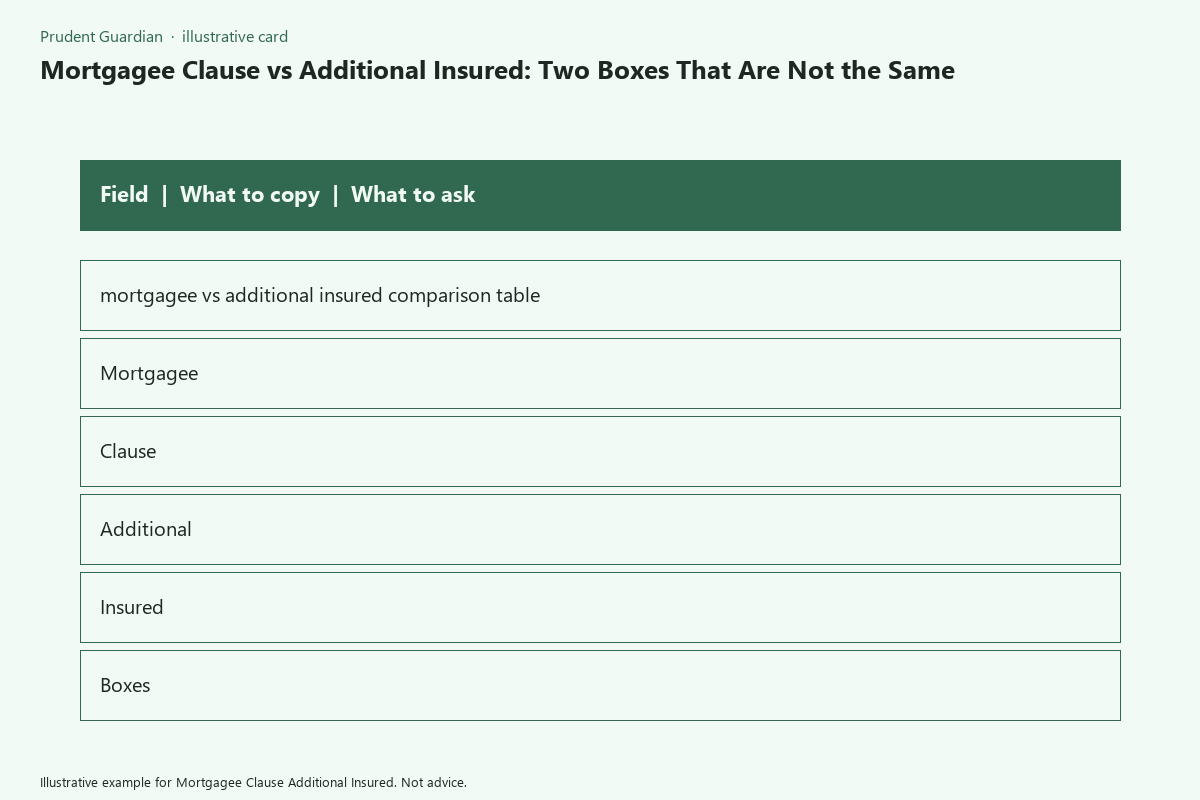
This comparison table outlines core differences between the mortgagee clause and additional insured boxes found on U.S. residential property insurance applications and active policy documents. Mixing up these two entries is one of the most common administrative errors on home insurance paperwork, leading to delayed claim payouts, forced-placed insurance charges, and non-compliance with mortgage loan terms. Prudent Guardian has developed this process guidance to help homeowners avoid these avoidable pitfalls. This content is purely educational, and does not constitute insurance, legal, or financial advice; always confirm all policy entries with your licensed insurance agent or mortgage servicer before finalizing coverage.
| Category | Mortgagee Clause Entry | Additional Insured Status Request |
|---|---|---|
| Eligible Parties | Only state or federally regulated mortgage lenders/servicers holding a recorded lien against the property | Any party with a documented legal ownership, occupancy, or financial stake not covered by the primary named insured (e.g., deed co-holder, long-term leaseholder, court-appointed property trustee) |
| Requirement Status | Mandatory for all mortgaged residential properties, per loan closing agreement terms | Optional unless required by a co-ownership contract, residential lease, or court order |
| Claim Payout Priority | Receives first disbursement for structural damage claims, up to the full remaining principal balance of the mortgage | Receives disbursement only after the mortgagee and primary named insured claims are fully satisfied, for their explicitly documented proportional stake |
| Coverage Scope | Limited to structural damage losses and lender losses stemming from borrower default linked to unaddressed property damage | Covers liability claims filed against the additional insured related to property use, plus any proportional structural damage benefits explicitly outlined in the add-on endorsement |
| Common Form Field Label Variations | “Lienholder Information”, “Loss Payee (Lender Only)”, “Mortgagee Details” | “Add Named Insured Party”, “Other Insured Entry”, “Additional Coverage Party” |
| Required Proof for Addition | Copy of closing disclosure listing the active mortgage servicer and full loan number | Copy of property deed, signed lease agreement, or court order verifying the party’s legal stake in the property |
Printed application boxes distinguishing mortgagee clause inputs from additional insured status requests
On both paper and digital home insurance applications, these two entry fields are often placed within 1-2 lines of each other, leading to accidental misentries. The mortgagee clause field will almost always include a mandatory sub-field for your full loan number, while the additional insured field typically includes a sub-field for the party’s relationship to the primary named homeowner. Entering a non-lender (such as a deed co-holder or family member) in the mortgagee clause field will result in an immediate application rejection, delaying policy activation and potentially delaying a home purchase closing. Entering your mortgage servicer in the additional insured field will not satisfy your loan’s insurance requirements, as the lender will not hold first-priority claim rights to damage payouts. Illustrative example: A first-time homebuyer entering their parent (a loan co-signer who is not on the mortgage lien) in the mortgagee clause box delayed their closing by 8 days while the policy was revised and reissued.

Standard insurance form sections defining mortgagee clause rights versus additional insured coverage limits
Virtually all U.S. residential property insurance policies use a variant of the standard ISO HO-3 form, which explicitly separates these two designations in distinct sections. The mortgagee clause is listed under Section 1 (Property Coverage) Conditions, within the Loss Payable Provisions subsection. This section grants the lender the right to file a structural damage claim independently of the homeowner, receive a payout even if the homeowner’s coverage is voided for fraud or non-disclosure, and receive 30 days’ advance notice of any policy cancellation, non-renewal, or coverage reduction. Additional insured status is either listed under Section 2 (Liability Coverage) in the Who Is An Insured subsection, or added via a separate endorsement attached to the main policy. Additional insureds only have access to the coverage explicitly outlined in their endorsement: a liability-only additional insured will not receive any structural damage payout, while an ownership-focused additional insured will only receive their proportional share of remaining funds after the mortgagee and primary insured are fully compensated. Additional insureds do not receive cancellation notices or have independent claim-filing rights for structural damage unless explicitly added via a separate endorsement add-on.
Physical document folder organization tips for mortgagee clause confirmations and additional insured verification records
Clear organization of these records will reduce claim processing delays and help you resolve disputes with your lender or insurance carrier quickly. Prudent Guardian recommends creating two dedicated subfolders in either your physical home insurance binder or password-protected cloud storage, labeled “Mortgagee Clause Confirmations” and “Additional Insured Verification” respectively. For the mortgagee clause folder, store a dated copy of your policy declarations page showing the full, approved clause, written confirmation from your mortgage servicer that they received and accepted the clause, and all correspondence related to clause updates if your loan is sold to a new servicer. For the additional insured folder, store a copy of the signed endorsement adding the party, the supporting documentation you submitted to verify their stake (deed, lease, court order), and a signed receipt from the additional insured confirming they have reviewed their coverage limits. Keep all records for at least 3 years after the policy term ends, or 7 years if you sell the property, to resolve any post-sale claim or lien disputes.
Issued coverage letter requirements for accurate listing of both mortgagee clauses and additional insured parties
As soon as you receive your official policy declarations page after applying for coverage, complete a line-by-line review of both sections to catch errors before the policy takes effect. For the mortgagee clause, confirm the full legal name of your servicer matches the name on your most recent mortgage statement, the loss payee mailing address matches the address listed on your servicer’s public website for insurance correspondence, and your full loan number is included with no typos or missing digits. If any of these details are incorrect, request a corrected declarations page from your agent within 10 days of receipt, and send a copy to your servicer immediately after you receive the revised document. For additional insured parties, confirm their full legal name is spelled correctly, their relationship to the property is listed accurately, and the exact scope of their coverage (liability-only, full ownership, etc.) is explicitly stated. If your lender is listed in the additional insured section instead of the dedicated mortgagee clause section, this is a critical error that requires immediate correction, as it violates your mortgage loan terms and will trigger forced-placed insurance charges if unaddressed. Illustrative example: A single transposed digit in a loan number on a mortgagee clause led to a $14,000 storm damage payout being sent to a closed loan account, delaying the homeowner’s roof replacement by 5 weeks.
Semi-annual check schedule for verifying mortgagee clause validity and additional insured status accuracy
Set a recurring twice-yearly reminder aligned with your January and July mortgage due dates to complete three simple verification tasks to keep your policy up to date. First, cross-check the mortgagee clause on your most recent declarations page against the servicer name and loan number on your most recent mortgage statement. If your loan was sold to a new servicer in the prior 6 months, contact your agent immediately to update the clause, and request written confirmation that the new servicer has received the updated declarations page. Second, review all listed additional insureds to confirm they still hold a valid stake in the property: if a co-owner has sold their share back to you, a long-term tenant has moved out, or a court order for trustee oversight has expired, request their removal from the policy to avoid unnecessary premium charges and coverage disputes. Third, request a one-sentence written confirmation from your insurance agent that both the mortgagee clause and all additional insured listings are active and compliant with your policy terms, and file this confirmation in the appropriate subfolder for your records. If you complete a major property renovation that increases your home’s replacement value by more than 10%, add an extra check to confirm the mortgagee clause remains accurate, as some lenders require notification of significant property changes.
Pull your most recent home insurance declaration page today and cross-check that your mortgage servicer is listed only in the mortgagee clause section, not the additional insured section, to avoid non-compliance penalties.