Educational overview only. Prudent Guardian (inspirecodingedu.com) is not an insurance company, broker, law firm, or registered investment adviser, and does not provide personalized insurance, investment, tax, medical, or legal advice. Verify details with licensed professionals and official issuers.
Legal claim paperwork preparation for household injury cases relies on side-by-side comparison of formal mass-tort intake documents and personal event timelines to build consistent, credible claim narratives. Mixing up these two document types can lead to gaps in submitted evidence, inconsistent date reporting, or accidental disclosure of irrelevant personal details during intake. Prudent Guardian provides this educational guidance to help you organize personal records without offering legal advice, and you should always direct claim-specific questions to your licensed legal representative. This page cannot bind coverage, a claim result, or a lawsuit.
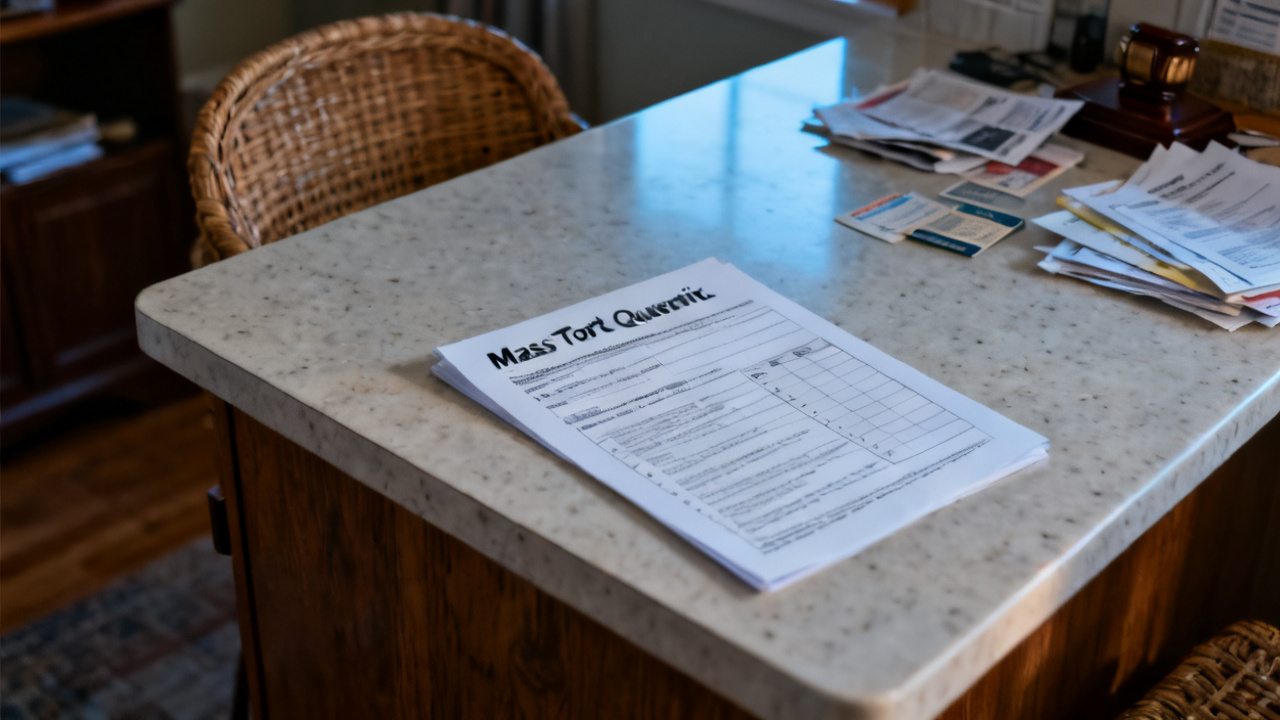
Printed questionnaire form fields that standardize mass-tort claim data points for intake teams
Mass-tort questionnaires are designed to eliminate variability across thousands of claims, so intake teams can quickly sort eligible claimants from those who do not meet case criteria. Fields are pre-aligned to the specific parameters of the active tort, such as exposure windows for a defective consumer product, implant date ranges for a faulty medical device, or purchase dates for a recalled medication. For example, if a mass tort relates to a specific model of hip implant implanted between 2017 and 2020, the questionnaire will have dedicated fields for implant date, implant serial number, and surgeon contact information, with no room for extra context about post-surgery symptoms unless a separate open field is explicitly included. Many questionnaires will flag as incomplete if you leave a mandatory field blank, even if you explain the missing information in an unprompted note scrawled on the form margin. You should always save a blank copy of the questionnaire before filling it out, so you can reference the original field prompts if you need to correct a submission later, or fill out an updated version of the form if requested.
Personal calendar entry chronology notes that capture firsthand injury-related event dates and details
Your personal chronology is a living document that you can update as you recall new details, receive new medical records, or experience new symptoms related to your claim. Unlike the questionnaire, it does not need to follow any pre-set structure: you can jot notes on a wall calendar, type entries in a phone note app, save transcripts of voice memos you record after doctor’s visits, or tape receipts for missed work or out-of-pocket medical expenses directly to the pages. This chronology serves as your personal reference when filling out the questionnaire, so you do not have to rely on memory to answer date-specific questions. For example, if the questionnaire asks for the first date you reported symptoms to a medical provider, your chronology may have a note from 18 months prior referencing a telehealth call where you mentioned unusual symptoms, which you may have forgotten if you only relied on formal printed medical records to fill out the form. You do not have to share your full chronology with anyone unless you choose to do so with your legal representative, so you can include unfiltered details that you may not want to include in formal claim submissions.
Manila folder tab labels that separate official mass-tort documents from personal timeline records
Using clearly labeled manila folders to separate these two document types prevents mix-ups during submission and ensures you can locate either set of records quickly when requested. Recommended tab labels for your folder set include: “Official Mass-Tort Questionnaires (Blank & Submitted)”, “Questionnaire Drafts & Worksheets”, “Personal Chronology Entries (All Versions)”, and “Chronology Supporting Documents (Receipts, Call Logs, Calendar Snippets)”. Never write notes or cross out entries directly on the official printed questionnaire you plan to submit, as this can lead to your form being rejected during automated intake screening. Instead, note any questions or discrepancies in your personal chronology folder, and share those notes separately with your legal team to address before you submit your formal questionnaire. Use the following comparison table to clarify the core differences between the two document types as you organize your folders:
| Category | Mass-Tort Questionnaire | Personal Chronology |
|---|---|---|
| Core Purpose | Standardize eligibility data for uniform intake screening across hundreds or thousands of claimants | Track firsthand event details, symptom notes, and unrecorded interactions for personal cross-reference |
| Allowed Content | Only data explicitly requested in pre-set fields; unprompted disclosures are only permitted if a dedicated open-response text box is provided | Any relevant date, symptom, conversation, receipt, or event related to your claim, with no content restrictions |
| Format Constraints | Strict, with required date formats, dropdown selections, and mandatory fields that must be completed to avoid form rejection | Fully flexible; can include handwritten notes, typed spreadsheets, calendar screenshots, voice memo transcripts, or taped receipts |
| Intended Audience | Exclusively shared with claim intake teams and your licensed legal representative | For your personal use only; you may choose to share specific excerpts with your legal team, but full submissions are rarely required |
| Retention Rule | Illustrative example: keep a signed, dated copy of all submitted versions for a minimum of 10 years after your claim is fully resolved | Keep all drafts and revisions indefinitely for personal reference and to support any future claim updates or supplementary filings |
| Admissibility Note | Considered formal claim documentation once signed and submitted | Not considered formal claim paperwork unless you and your legal representative explicitly choose to submit verified excerpts as supporting evidence |
Certified mail letter attachments that validate timestamp accuracy for both submitted document types
Certified mail provides independent, postmarked proof of when you submitted documents and what contents were included, which eliminates disputes about submission timelines later in the claim process. When you submit a completed mass-tort questionnaire, always send it via certified mail with a return receipt requested, and include a dated cover sheet that lists the questionnaire version number, the number of pages included in the form, and any supporting medical records or identification documents you are attaching to the submission. Save a copy of the cover sheet, certified mail receipt, and returned delivery confirmation in your official questionnaire folder. For your personal chronology, you can validate the accuracy of your entries by mailing a dated, signed printed copy of your current chronology to yourself via certified mail once every 6 months, as an illustrative example. Do not open the envelope when it arrives; the sealed postmarked envelope serves as independent verification that the details contained in the chronology were recorded by the postmark date, if you ever need to confirm your timeline of events at a later date. Store all sealed certified mail chronology copies in your personal chronology folder, separate from your working draft notes.
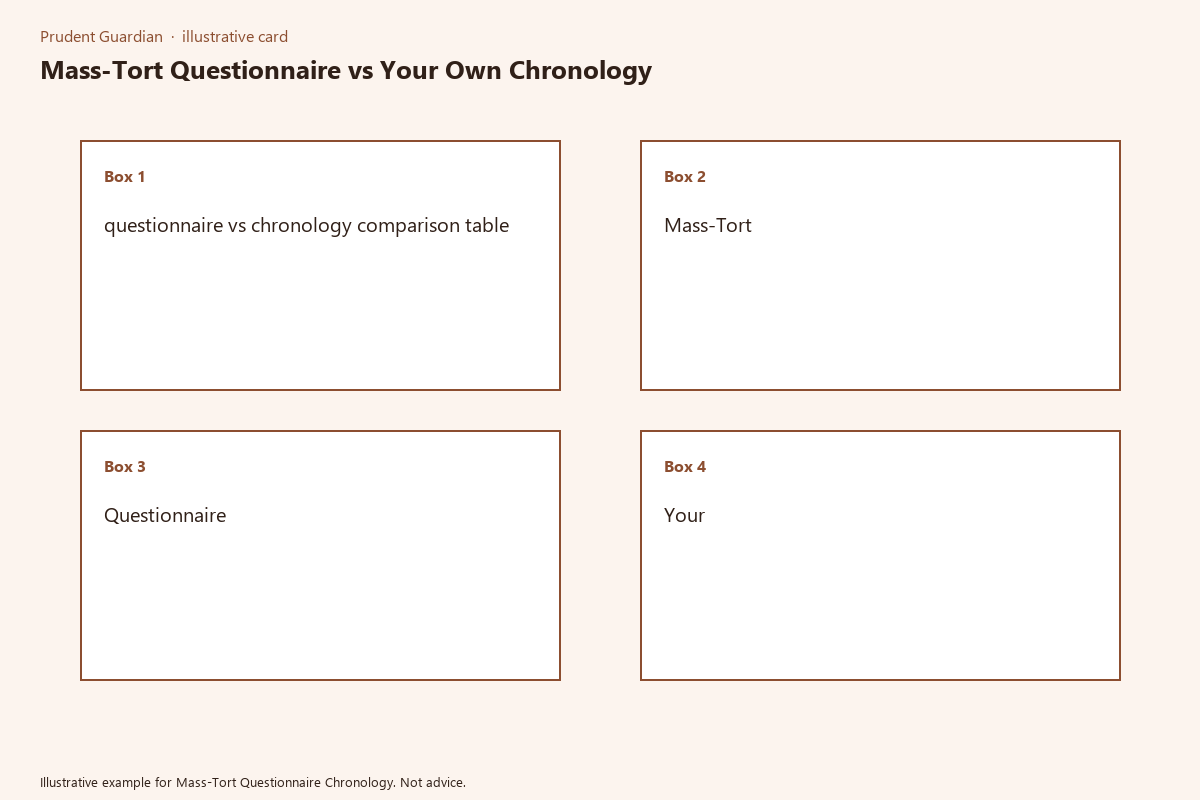
Archival storage box dividers that organize questionnaire drafts and chronology revisions for long-term safekeeping
Mass-tort cases often take multiple years to progress from initial intake to final resolution, so long-term, damage-proof storage of all versions of both your questionnaires and chronology notes is critical. Use acid-free archival storage boxes to prevent paper degradation over time, and use labeled cardstock dividers to separate your folder contents by document type and date. Recommended divider sections for your archival box include: “Blank Questionnaires & Intake Notices”, “Completed Questionnaire Drafts (Sorted by Date)”, “Submitted Questionnaires & Certified Mail Receipts”, “Personal Chronology Working Drafts (Sorted by Date Range)”, “Sealed Certified Mail Chronology Copies”, and “Correspondence Related to Questionnaire or Chronology Updates”. Make a digital scan of every document in the box, including the front and back of all certified mail receipts, and store the scans on a password-protected external hard drive kept in a separate location from the physical box, such as a fireproof safe or a safe deposit box. Never discard old drafts or outdated versions of either document, even if you submit an updated questionnaire or revise your chronology to include new details. Older drafts can help resolve any questions about inconsistent date reporting or detail disclosures that may arise during claim processing.
This week, pull your most recent blank or draft mass-tort questionnaire and your current personal chronology, and cross-reference every date field on the questionnaire against your timeline notes to flag any discrepancies to discuss with your licensed legal representative.