Educational overview only. Prudent Guardian (inspirecodingedu.com) is not an insurance company, broker, law firm, or registered investment adviser, and does not provide personalized insurance, investment, tax, medical, or legal advice. Verify details with licensed professionals and official issuers.
This ordinance or law coverage field card standardizes how property owners and claims adjusters track reconstruction limit caps and local building code requirements during post-loss property repairs. It eliminates gaps between the actual cost to bring a damaged structure up to current municipal codes and the standard coverage limits that only pay to repair a property to its pre-loss condition. Many property owners overlook this coverage add-on until a claim is filed, leading to unexpected out-of-pocket costs for upgrades like fire-resistant siding, accessibility ramps, or updated electrical systems mandated by local ordinances passed after the original structure was built. This Prudent Guardian process page outlines actionable, document-focused steps to validate eligibility, track adjustments, and store records to minimize coverage disputes. This page is for educational use only, does not bind coverage, and all coverage determinations are made by your insurance carrier per your official policy terms.
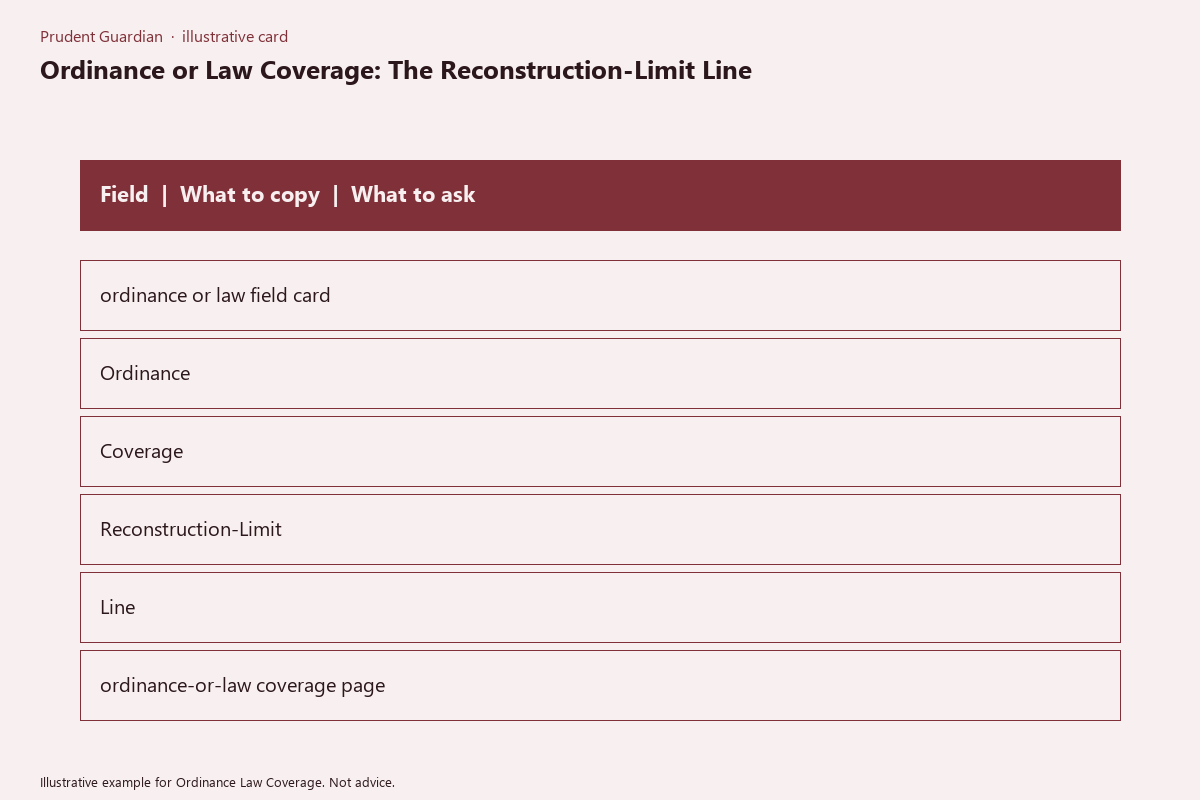
The reusable ordinance or law field card below is designed to be filled out as you gather documentation and work with your adjuster:
| Field Card Section | Required Information | Verification Checkbox | Notes |
|---|---|---|---|
| Eligibility Confirmation | Active policy endorsement explicitly listing ordinance or law coverage | ☐ | Stated coverage limit: $________ |
| Local Code Validation | Written, dated confirmation from municipal code enforcement of required post-loss upgrades | ☐ | Applicable code section number(s): ________ |
| Adjuster Approval Log | Signed adjuster confirmation letter outlining approved payout terms | ☐ | Approved amount: $________ Benefit expiration date: ________ |
| Inspection Milestone Tracking | All passing code inspection certificates for reconstruction work | ☐ | Final compliance inspection date: ________ |
| Record Storage Confirmation | Secured physical and encrypted digital copies of all supporting documents | ☐ | Digital storage location (cloud/external drive): ________ |
Printed claim form sections for ordinance or law coverage eligibility verification
Start by pulling your official property insurance claim form and policy endorsement packet to cross-reference against the eligibility confirmation section of your field card. Focus on four specific form sections to avoid missing critical eligibility rules. First, the policy endorsements addendum, specifically the line item labeled “Ordinance or Law Coverage Limit” or “Building Code Upgrade Coverage” – circle this line and note the limit on your field card to confirm the maximum payout you are eligible to receive for code-related work. Second, the loss type eligibility section, which specifies if coverage applies to partial losses or only total losses, and any exclusions for code updates that were legally required but unaddressed before the loss occurred. Third, the additional living expense (ALE) alignment section, which notes if extended temporary housing costs related to code-mandated reconstruction delays are covered under your ordinance or law benefit. Fourth, the proof of compliance submission requirements, which lists the exact municipal documents you need to provide to validate that requested upgrades are legally required, not optional cosmetic changes. If you find ambiguous language in any of these sections, submit a written request to your carrier for formal clarification, as verbal statements from adjusters are not binding for coverage determinations.
Color-coded folder tabs for separating local code updates and policy limit documents
Use four color-coded manila folder tabs to organize all supporting documentation for your ordinance or law claim, aligned to the first two sections of your field card. Assign neon green to the first tab, which holds official current municipal building code extracts printed directly from your local code enforcement office website or obtained in person from the municipal clerk, with the specific section requiring the upgrade highlighted and dated within 30 days of the loss. Assign bright blue to the second tab, which holds your policy declaration pages and endorsement documents, with the ordinance or law coverage limit line circled and any exclusion language marked with a sticky note for your adjuster to address. Assign orange to the third tab, which holds detailed contractor bids that separate pre-loss repair costs from code-upgrade costs, with each line item for code-related work tied to the corresponding municipal code section from your green tab folder. Assign purple to the fourth tab, which holds all correspondence with your adjuster related to ordinance or law coverage requests, including email printouts, dated call logs, and mailed notices. Write your full claim number in the top right corner of every document placed in these folders to prevent misfiling during carrier processing.
Adjuster confirmation letter fields to log approved reconstruction limit adjustments
When your adjuster sends a formal written confirmation of your ordinance or law coverage approval, cross-reference every field against the adjuster approval log section of your field card to ensure no critical details are missing. First, confirm the approved total ordinance or law payout amount is listed explicitly, and cross-check it against your policy’s stated limit to ensure no underpayment. Second, verify the letter includes a clear breakdown of approved costs between demolition of non-compliant structure portions, code-required material or structural upgrades, and extended ALE if applicable. Third, log the stated expiration date for the approved benefit, to ensure you complete all work and submit final receipts before the cutoff to avoid forfeiting unused funds. Fourth, confirm the letter includes the adjuster’s full contact information, claim reference number, and signature, as unsigned or incomplete letters are not valid for binding coverage. If the adjuster denies part or all of your request, log the denial reason and date on your field card, and request a written explanation of the denial within 10 business days per your state’s insurance regulations. You may share that denial letter with a licensed insurance professional if you wish to appeal the decision. Remember that Prudent Guardian does not provide legal or claims adjustment advice, and all appeal processes are governed by your policy terms and state insurance rules.
Reconstruction timeline schedule entries for tracking code compliance inspection milestones
Add five non-negotiable code compliance milestones to your reconstruction timeline, and log each completion date in the inspection milestone tracking section of your field card. First, the pre-reconstruction code inspection date, when the local code officer assesses the damaged structure and provides a written list of required upgrades to bring the property up to current code. Second, the plan submission date for revised construction plans that incorporate all required code upgrades, submitted to the code enforcement office for formal approval before work begins. Third, the rough-in inspection date, for electrical, plumbing, and structural work that must be signed off before finishing work like drywall or flooring can proceed. Fourth, the final code inspection date, when the code officer issues a certificate of occupancy or certificate of compliance confirming all work meets current municipal ordinances. Fifth, the final receipt submission date to your insurance carrier, scheduled within 10 business days of passing final inspection, to receive the remaining approved ordinance or law payout. Illustrative example: if your municipality passed a 2022 ordinance requiring all new residential roofing to be impact-resistant, and your pre-loss 2018 roof did not meet this standard, you will log the pre-reconstruction inspection that confirms the new roof must meet the 2022 rule, and track all subsequent inspection dates to ensure work is approved before you submit your final receipt. If code office backlogs or supply chain delays extend your timeline, notify your adjuster in writing immediately to request a benefit period extension if applicable.
Waterproof document box compartments for storing physical copies of the field card and supporting records
Use a standard 4-compartment waterproof, fire-resistant document box to store all physical records related to your ordinance or law claim, aligned to the record storage confirmation section of your field card. Place your signed, completed field card in a clear plastic sheet protector in the first compartment, for quick access if you need to reference claim details during calls with your adjuster or code office. Store full copies of all documents from your color-coded folders in the second compartment, organized in the same tab order for fast retrieval if you need to escalate a claim dispute. Place original inspection certificates and paid contractor receipts in sealed plastic envelopes in the third compartment, to protect them from moisture or fire damage. Store copies of the adjuster’s signed confirmation letter and all payout receipts in the fourth compartment, to cross-reference with your tax records if you need to report claim proceeds for tax purposes. Choose a document box rated for at least 1 hour of fire resistance and full water submersion, and store it in a secure, elevated location in your home to avoid flood damage. Scan every document stored in the box and save encrypted digital copies to a cloud storage account or external hard drive, so you can access records even if the physical box is damaged or lost in a subsequent event.
Your first practical next step is to print the ordinance or law field card above, pull your current property policy declaration page, and fill out the eligibility confirmation section today to verify if you have active ordinance or law coverage.
Written by the Prudent Guardian editors.