Educational overview only. Prudent Guardian (inspirecodingedu.com) is not an insurance company, broker, law firm, or registered investment adviser, and does not provide personalized insurance, investment, tax, medical, or legal advice. Verify details with licensed professionals and official issuers.
This printable sudden water damage vs seepage denial-language reference card helps users parse standardized insurance carrier phrasing used in official coverage denial communications. Misclassification between sudden accidental water damage (typically a covered peril in most standard property policies) and seepage or gradual moisture damage (almost always an excluded peril) is one of the most frequent causes of water damage claim denials nationwide. This resource is for educational use only, provided by Prudent Guardian, and does not bind coverage, adjust claim outcomes, or replace guidance from your insurance carrier, licensed public adjuster, or legal representative. You can use the tools below to organize your claim paperwork and cross-reference denial wording directly against your policy’s explicit terms.
Prudent Guardian editors

Denial letter phrasing markers for sudden accidental water damage claims
When a carrier denies a claim filed as sudden accidental water damage, they will use standardized phrasing to communicate that the reported damage does not meet their internal definition of a covered sudden event. Common markers to highlight directly on your physical or digital denial letter copy include: explicit rejection of the discrete event timeline you submitted, references to a lack of documented proof of a pipe burst, appliance supply line rupture, storm-driven water incursion, or other abrupt water release, statements that the damage appears to have occurred over an extended period rather than within a 72-hour window, and notes that your submitted maintenance records do not confirm the affected area was fully dry immediately prior to the reported incident. If you see three or more of these markers in your denial letter, the carrier is almost always classifying the damage as seepage rather than sudden, even if the word “seepage” does not appear in the opening paragraph of the notice. You can flag each marker with a colored highlighter to make cross-referencing faster later.
Claim form annotation prompts matching formal seepage denial wording
Once you have highlighted relevant phrasing on your denial letter, use these prompts to annotate your copy of the original claim form you submitted, so you can align your submission details directly with the carrier’s denial rationale: 1. Add the denial letter’s reference number and date in the top margin of your claim form, 2. Next to each line item describing damage on your claim form, write the exact phrase from the denial letter that addresses that specific damage, 3. Note any gaps between the carrier’s stated timeline for moisture exposure and the timeline you submitted, including dates of photos, repair estimates, or witness statements that support your original timeline, 4. Flag any references to “failure to maintain” or “unaddressed leaks” in the denial letter, and add cross-references to maintenance receipts, inspection reports, or plumbing records you submitted with your claim, 5. Jot down any questions you have about the denial wording in the bottom margin to reference during calls with your carrier. Avoid making edits to the original claim form you submitted; only add notes to your personal copy for your own records.
Physical folder tab labels for cross-referenced denial language examples
Organize all paperwork related to your water damage claim in a single dedicated folder with these pre-printed tabs, so you can locate supporting documents in seconds during carrier calls or meetings with licensed professionals: 1. Highlighted Denial Letter (Original & Copy), 2. Original Submitted Claim Form (Annotated), 3. Policy Declarations & Exclusion Text (Water Damage Sections Only), 4. Supporting Documentation (Photos, Receipts, Inspection Reports), 5. Carrier Correspondence Log (Date, Contact Name, Summary of Discussion). Tuck the printable denial-language reference card in the front pocket of the folder to quickly cross-reference new phrasing you encounter during calls or follow-up communications from your carrier. This folder structure eliminates the need to sort through loose paperwork mid-call, so you can reference exact details without delays.
Policy schedule cross-reference entries for water damage exclusion terms
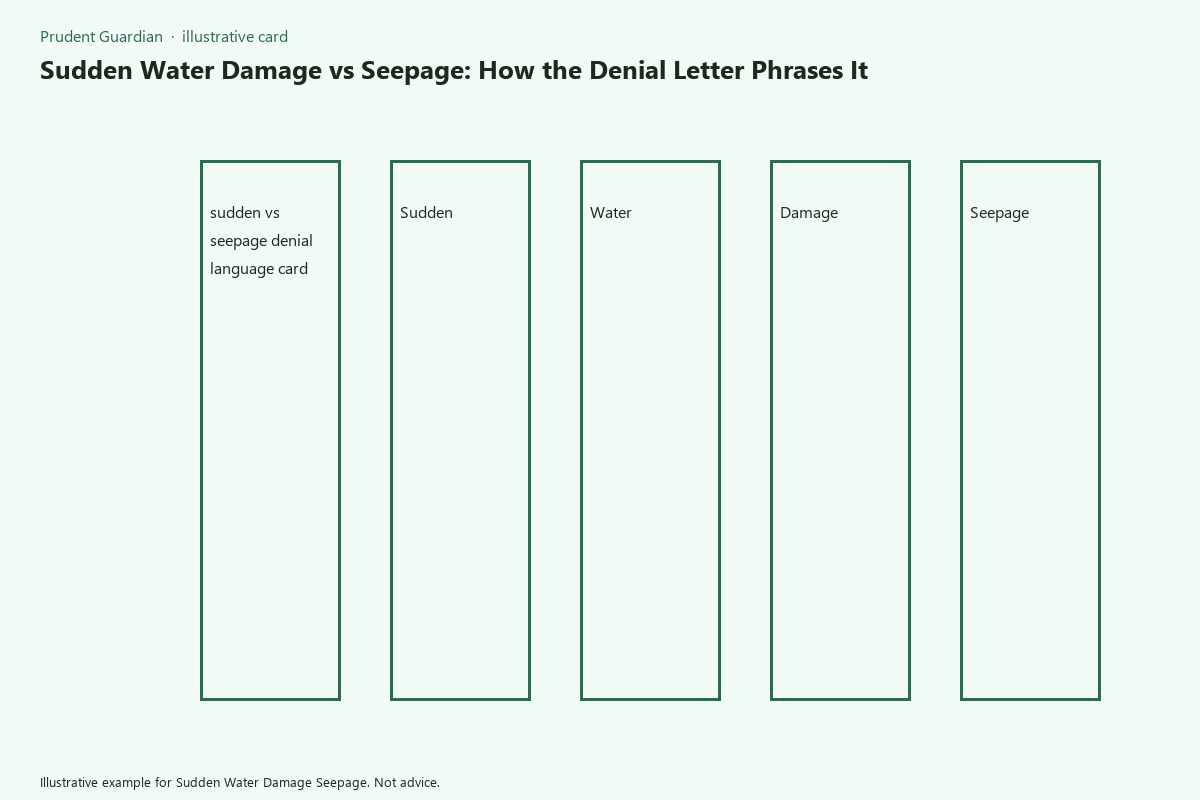
The core of this resource is the printable sudden vs seepage denial-language reference card, which you can use to match denial phrasing directly to terms listed in your policy’s exclusion section. The table below is an illustrative example of the card you can customize for your specific policy:
| Denial Phrase Category | Phrase Indicating Sudden Damage Rejection | Phrase Indicating Seepage Classification | Policy Exclusion Cross-Reference Line (Fill in your own policy details) |
|---|---|---|---|
| Event Timing | No evidence of discrete, time-stamped water release event | Damage consistent with moisture exposure over 3+ months | |
| Cause of Damage | No proof of pipe burst, appliance failure, or storm incursion | Damage linked to unaddressed pipe leak, foundation crack seepage, or faulty flashing | |
| Maintenance History | Claimant failed to document prior dry conditions in the affected area | Property records indicate prior reports of dampness in the same location | |
| Damage Scope | Affected materials show no evidence of sudden saturation | Affected materials show layered mold growth, rotted wood, or progressive staining | |
| Policy Definition Match | Reported incident does not meet policy definition of “sudden and accidental” | Reported damage falls under policy definition of “seepage, leakage, or gradual moisture” |
To use this card, pull up the water damage exclusion section of your policy schedule, write the exact line number and exclusion wording for each row that matches phrasing in your denial letter, and keep the card with your claim folder for quick access. You can print multiple copies of the card if you are cross-referencing denials for multiple properties or claims.
Clear storage box divider labels for sorted denial letter copies by damage type
If you manage multiple properties, have filed multiple water damage claims, or keep records for household and rental properties in a single location, use these pre-printed divider labels for a 12-quart clear storage box to keep all denial letters and associated paperwork organized by damage type and property class: 1. Residential Primary Home: Sudden Water Damage Denials, 2. Residential Primary Home: Seepage Denials, 3. Residential Rental Properties: Sudden Water Damage Denials, 4. Residential Rental Properties: Seepage Denials, 5. Commercial Property (if applicable): Sudden Water Damage Denials, 6. Commercial Property (if applicable): Seepage Denials, 7. General Policy Exclusion Documents (All Properties). Each divider section should hold only the denial letter and associated annotated claim form for that specific claim, with supporting documentation stored in the general section if it applies to multiple properties. Clear storage boxes make it easy to locate your entire water damage claim file at a glance, even if it is stored with other household paperwork in a closet or attic.
Print the reference card table above, fill in your policy’s exclusion line numbers for each category, and highlight any matching phrasing on your denial letter before your next scheduled call with your insurance carrier’s claims department.