Educational overview only. Prudent Guardian (inspirecodingedu.com) is not an insurance company, broker, law firm, or registered investment adviser, and does not provide personalized insurance, investment, tax, medical, or legal advice. Verify details with licensed professionals and official issuers.
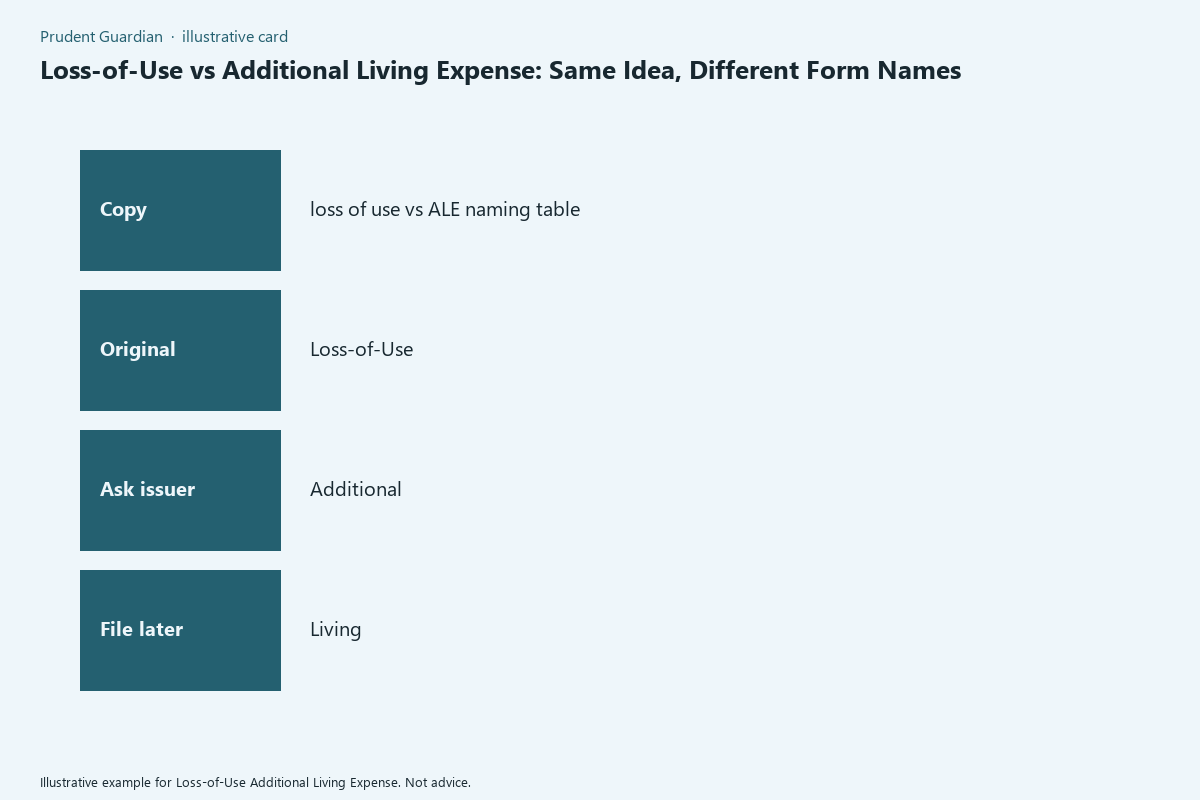
Homeowners insurance paperwork regularly includes interchangeable terms for identical post-damage temporary living benefit categories. Loss-of-Use and Additional Living Expense (ALE) are the two most common labels for this benefit, which covers costs you incur when your home is unlivable due to a covered peril, such as a fire, storm damage, or burst pipe. Confusion between these two terms can lead to delayed reimbursement, accidental underuse of available benefits, or misallocation of claim funds across coverage categories. This educational material is for paperwork organization only, and does not bind coverage, adjust claim outcomes, or constitute legal advice; always confirm policy terms with your licensed insurance agent or carrier representative.
Indexed coverage term matching form
This table is designed to eliminate term confusion by mapping common form types to their standard temporary living benefit labels, so you can quickly cross-reference across documents without repeatedly contacting your carrier. You can download a blank editable version of this table from Prudent Guardian for your personal use, and add custom rows for carrier or state-specific forms relevant to your claim.
| Form Type | Common Term Used | Standard Covered Expenses For This Category | Equivalent Term On Other Forms |
|---|---|---|---|
| HO-3 Homeowners Policy Declarations Page | Additional Living Expense (ALE) | Temporary rent, meal costs above your normal grocery budget, pet boarding, laundry services, temporary utility setup fees, and reasonable travel costs to access temporary housing | Loss-of-Use |
| State-Mandated Claim Reimbursement Form (e.g., Texas, Florida, California DOI required forms) | Loss-of-Use | Identical to ALE coverage as outlined in your base policy | Additional Living Expense (ALE) |
| HO-4 Renters Policy Endorsement | Loss-of-Use (Section D Coverage) | Temporary rent, storage for undamaged personal property, meal overages, and pet boarding for renters displaced from their leased unit | Additional Living Expense (ALE) |
| Commercial Multi-Unit Property Claim Form | Additional Living Expense (tenant-facing) | Temporary housing costs for tenants displaced from a damaged rental unit | Loss-of-Use (used for owner-occupied unit claims on the same form) |
| Adjuster Preliminary Damage Assessment Worksheet | Either term, depending on adjuster training | All eligible temporary living costs outlined in your policy, regardless of label | The alternate term not used on the worksheet |
When filling out claim forms, use the term listed for that specific form type to avoid processing delays, and reference the equivalent term in your policy if you receive a request for clarification from a claims processor.
Labeled policy term reference folder
This portable folder holds all relevant documentation related to your temporary living benefit, so you can access consistent information during calls with adjusters, in-person claim meetings, or when submitting reimbursement requests. Use the following tab structure for easy navigation:
- Tab 1: Full signed policy documents, with the section listing temporary living benefits highlighted, and a handwritten note in the margin confirming the equivalent term if your policy only uses one label.
- Tab 2: All carrier correspondence, including claim acknowledgment letters, adjuster emails, and reimbursement updates, each with a sticky note mapping the term used in the document to the term listed on your policy.
- Tab 3: All receipts and reimbursement requests, labeled with the term the carrier used in their most recent communication to ensure claims processors allocate your expenses to the correct coverage bucket.
- Tab 4: A printed copy of the indexed coverage term matching table for quick reference during conversations with carrier staff.
Store both digital and physical copies of this folder to ensure you can access it even if your home is damaged and you cannot retrieve physical documents.
Adjuster terminology clarification letter
If you receive documents that use conflicting terms, or if your adjuster uses one term verbally but your policy uses the other, send this short written clarification letter to eliminate ambiguity and create a paper trail of agreed-upon terms for the claim. Include these exact components to avoid misinterpretation:
- Core identifying details at the top: your full name, property address, claim number, and date of loss.
- A clear, direct request for confirmation: “I request written confirmation that for the purposes of this claim, the terms ‘Loss-of-Use’ and ‘Additional Living Expense’ refer to the same temporary living benefit outlined in Section [insert section number from your policy] of my policy dated [insert policy effective date].”
- A request for confirmation of applicable limits and restrictions: “Please also confirm the total coverage limit for this benefit, any per-day spending caps, and any excluded expenses that apply, regardless of which term is used in future correspondence.”
- A request for a timely response: “Please send this written confirmation via email or certified mail within 10 business days to avoid delays to my reimbursement requests.”
Send this letter via certified mail with a return receipt requested, and save a copy in your reference folder, so you have proof of the request if there is a future dispute over benefit eligibility. This is a standard administrative request, not a formal complaint, and most adjusters will respond quickly to eliminate any term confusion.
Timed term verification schedule
Regular check-ins to confirm consistent term use across all documents prevent costly mistakes later, such as accidental deduction of temporary living expenses from your dwelling repair budget. Schedule these four checkpoints for every active claim:
- First checkpoint: Within 72 hours of receiving your initial claim acknowledgment letter from the carrier. Cross-reference the term used for temporary living benefits in the letter against the term on your policy. If they differ, draft and send your clarification letter immediately.
- Second checkpoint: Every time you submit a reimbursement request. Confirm that the term you use on your request cover sheet matches the term used in the most recent written communication from your adjuster. This reduces the chance that a processor will reject your request or allocate it to the wrong coverage category.
- Third checkpoint: When you have used 75% of your available temporary living benefit. Cross-reference all previous reimbursement statements to ensure all charges have been applied to the correct benefit category, and no charges have been accidentally deducted from your personal property or dwelling repair coverage limits. Illustrative example: If your total temporary living benefit limit is $20,000, you would run this check when you have received $15,000 in reimbursements, to confirm no funds were misallocated before you hit your limit.
- Fourth checkpoint: 7 days before your claim is scheduled to close. Do a final cross-reference of all documents to confirm that all temporary living expenses you submitted were applied to the correct benefit, and that you have received all eligible reimbursements.
Set calendar reminders for these checkpoints to ensure you don’t miss them during the chaos of a post-damage claim.
Archived historical claim file box
After your claim is closed, storing all related paperwork long-term prevents issues with future claims, tax filings, or policy disputes. Include these items in your archive, stored in a fireproof, waterproof file box or password-protected cloud storage folder for at least 7 years:
- A full copy of your labeled policy term reference folder, including the term matching table and all clarification correspondence with your adjuster.
- All receipts, reimbursement requests, and carrier payment confirmations, sorted by date, with clear labels noting which term was used for each transaction.
- A one-page summary sheet that lists the total temporary living benefit limit for the claim, the total amount you were reimbursed, and a note confirming that the carrier recognized Loss-of-Use and ALE as equivalent for this claim.
If you switch insurance carriers in the future, you can use the summary sheet to ask your new agent which term they use for this benefit on your new policy, so you are familiar with the terminology before you ever need to file a claim.
Print a copy of the indexed coverage term matching table, cross-reference it against your current homeowners or renters policy declarations page, and add your policy’s specific temporary living benefit term and limit to the table’s notes column today.