
Educational overview only. Prudent Guardian (inspirecodingedu.com) is not an insurance company, broker, law firm, or registered investment adviser, and does not provide personalized insurance, investment, tax, medical, or legal advice. Verify details with licensed professionals and official issuers.
This index-crediting field map outlines consistent placement for index cap, participation, and spread data points on all indexed contract household paperwork crediting pages. You can use this structure to cross-reference disclosures, quarterly updates, and annual statements from your contract issuer to spot mismatches or unannounced changes before crediting is applied. Prudent Guardian has tested this mapping framework for standard indexed annuity and indexed life insurance crediting page formats, though it does not supersede issuer-specific disclosures or advice from your licensed contract agent. All data pulled for this map should be verified directly with your issuing carrier before taking any action related to your contract.
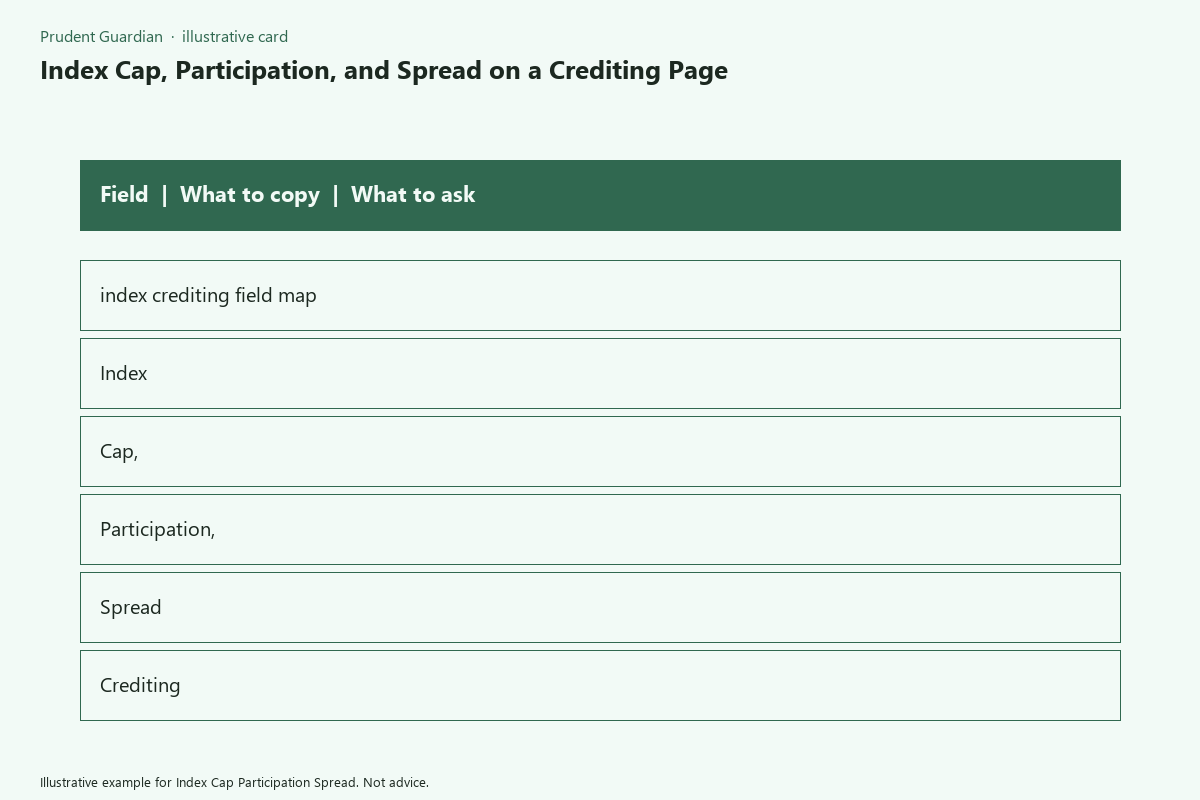
The below index-crediting field map identifies standard locations for each core data point on a typical carrier-issued crediting page, which you can reference for all the tracking steps outlined in the following sections. This map is for educational purposes only and cannot bind coverage, adjust a claim result, or serve as legal evidence in any dispute; always reference your official contract documents and consult a licensed professional if you have questions about your specific terms.

| Data Point | Standard Crediting Page Location | Cross-Reference Document |
|---|---|---|
| Index Cap | Top-right section of the page, listed under “Crediting Period Terms” | Index cap tracking form, original contract disclosure |
| Participation Rate | Directly below the index cap, in the same “Crediting Period Terms” section | Participation rate filing folder notices |
| Spread | Listed under “Crediting Calculation Details”, below the participation rate | Spread calculation confirmation letter |
| Applied Credited Interest | Bottom section of the page, under “Period Interest Applied” | Quarterly crediting update schedule, archived statements |
Index cap tracking form
This form is designed to log every crediting period’s stated and applied index cap, creating a consistent paper trail you can use to resolve discrepancies with your carrier. You will fill out one line per crediting period, even if the cap remains unchanged from the prior period, to avoid gaps in your records. If you spot a mismatch between the stated cap in your disclosures and the cap listed on your crediting page, mark the mismatch flag and document all follow-up actions in the corresponding column. Illustrative example: if your contract disclosure states a 7% cap for a 1-year S&P 500 point-to-point crediting period, but your crediting page lists a 5% cap, you will note the mismatch, log the date you contacted customer service, the name of the representative you spoke with, and the resolution (e.g., carrier confirmed data entry error, adjusted cap to 7% within 3 business days) in the form. You should attach a copy of any written correction notice from the carrier to the relevant line item in the form for future reference. Store completed forms in your participation rate filing folder for easy cross-reference with other contract documents.
Participation rate filing folder
This physical or cloud-based folder stores all official carrier documentation related to participation rate changes for the full term of your contract. Most indexed contracts allow carriers to adjust participation rates at the start of each new crediting period, as long as they provide written notice within the timeline required by your state’s insurance regulations, so this folder will serve as your official record of all rate adjustments you were notified of. Organize folder contents chronologically by crediting period to simplify cross-referencing when new crediting pages arrive. Use this dense checklist to ensure your folder is complete:
- Signed copy of your original contract’s participation rate schedule, dated the day you signed the contract
- All written notices of participation rate changes sent by the carrier 30+ days before the start of the applicable crediting period
- Printed copies of state insurance department filing confirmations for any rate changes, available upon request from your carrier or directly from your state’s insurance regulator
- Side-by-side comparison of stated participation rate from your notices vs. the rate applied on each crediting page
- Copies of all written responses from the carrier to questions you have about participation rate adjustments
If your carrier fails to provide a required notice of rate change, you can reference the gap in your folder when submitting a formal correction request.
Spread calculation confirmation letter
The spread (sometimes labeled a margin or administrative fee in carrier disclosures) is the percentage of index gains subtracted before your credited interest is calculated, so a written confirmation of the spread applied each period is critical to verifying your crediting page math is accurate. If the spread is explicitly listed on your crediting page, you can cross-reference it with your original contract disclosures to confirm alignment; if it is not listed, or if you spot a discrepancy between the credited interest amount and your own calculation, submit a written request to your carrier for a spread calculation confirmation letter. This letter will break down the full crediting calculation line by line, including the index return for the period, applied participation rate, applied spread, applied cap, and final credited interest amount. Illustrative example: if the index returned 9% for the period, your participation rate is 90%, your spread is 1.5%, and your cap is 6%, the letter should show a pre-cap gain of 6.6% (9% * 0.9 = 8.1% minus 1.5% = 6.6%) adjusted down to the 6% cap for your final credited interest. You are entitled to this letter free of charge within 10 business days of your request per most state insurance rules, and you should store a copy of each letter in your participation rate filing folder.
Quarterly crediting update schedule
This calendar-based schedule tracks all key deadlines related to crediting disclosures, statement delivery, and dispute windows to ensure you do not miss the opportunity to flag errors before interest is permanently applied to your contract. Sync all dates to your personal or work calendar with automated reminders to avoid oversights, and update the schedule as soon as you receive each document or complete a follow-up action. Use the below table to build your schedule:
| Event | Scheduled Date | Date Received | Days Remaining to Dispute (per state rules) | Confirmation of Receipt Sent (Y/N) |
|---|---|---|---|---|
| Pre-crediting cap/participation/spread disclosure issued | ||||
| Preliminary crediting page posted to your online account | ||||
| Physical crediting page mailed to your address on file | ||||
| Deadline to submit correction request to carrier | ||||
| Deadline to escalate unresolved concerns to state insurance regulator |
Dispute windows typically range from 30 to 90 days after the crediting page is issued, so confirm the applicable timeline for your contract with your carrier or state insurance department when setting up your schedule.
Archived crediting data storage box
This long-term storage solution holds all physical and digital copies of your crediting-related paperwork for the full term of your contract plus 7 years after the contract matures, is surrendered, or pays out a death benefit, to resolve any future disputes about credited interest. Use a fireproof, waterproof physical box for hard copies, and store digital backups in two separate secure locations (one encrypted cloud drive and one password-protected external hard drive stored off-site) to prevent loss in case of a home disaster. Label the box clearly with your contract number, carrier name, and contract start and end dates, and share access instructions with your trusted power of attorney or beneficiary so they can locate records if you are unable to do so. You may discard records 7 years after the contract is no longer active, unless you have an ongoing dispute related to crediting, in which case you should keep all records until the dispute is fully resolved.
Within 7 days of receiving your next crediting page, use the index-crediting field map to cross-reference all three core data points against your stored disclosures and flag any discrepancies for follow-up with your carrier.
Written by the Prudent Guardian editors.