Educational overview only. Prudent Guardian (inspirecodingedu.com) is not an insurance company, broker, law firm, or registered investment adviser, and does not provide personalized insurance, investment, tax, medical, or legal advice. Verify details with licensed professionals and official issuers.
This reference document maps every labeled field on a standard homeowners insurance declaration page to separate dwelling, contents, and other structures coverage values to eliminate misclassification errors. Mixing these two core coverage categories often leads to underinsurance mistakes when updating your policy, or incorrect claim filing after a loss that can delay payout. All guidance here is for educational use only from Prudent Guardian; always confirm coverage terms directly with your insurance carrier or licensed agent, as this document does not bind coverage, adjust claim payouts, or modify existing policy terms.
Prudent Guardian editors
Printed declaration page core coverage section breakdown
The core coverage section is almost always located on the first page of your declaration document, below the administrative block that lists your full name, property address, policy number, effective and expiration dates, and total annual premium. Many carriers separate this section with a bold border or shaded background to make it easy to locate, but smaller regional carriers may print it inline with other policy details. All coverage lines in this section are labeled with standard coverage codes (A through D) that align with the National Association of Insurance Commissioners (NAIC) standard homeowners policy format, so you can use those codes as a reliable anchor even if your carrier uses custom label text. The first three coverage codes correspond to the three core property coverage categories: Coverage A for dwelling, Coverage B for other structures, and Coverage C for contents. Coverage D, for loss of use, is a separate supplementary coverage that applies only if you are displaced from your home after a covered loss. Deductible lines are listed directly below each coverage limit on most policies, though some carriers use a single blanket deductible that applies to all property coverage categories.
Dwelling coverage line item limit field mapping guide
All dwelling coverage falls under Coverage A on 98% of standard HO-3, HO-5, and HO-6 condo policies, so start by locating the Coverage A label in the core coverage section. The fields associated exclusively with dwelling coverage are as follows: First, the Coverage A header, usually printed in bold text, which may be labeled “Dwelling”, “Main Residential Structure”, or “Primary Home” depending on your carrier. Second, the limit field, listed directly to the right of the Coverage A label, which is the maximum amount your carrier will pay to rebuild or repair the physical, permanently attached structure of your home. This includes attached decks, built-in appliances, foundation, roofing, permanent cabinetry, wall-to-wall carpeting, and built-in light fixtures. Third, the per-occurrence deductible line, listed directly below the Coverage A limit, which applies only to dwelling-related claims unless your policy uses a blanket deductible. Fourth, any dwelling-specific endorsements listed indented below the Coverage A limit, such as ordinance or law coverage, which extends the dwelling limit to cover local building code updates required after a loss. Illustrative example: If your Coverage A line lists a $425,000 limit, this is the full dwelling rebuild amount, and does not include any of your $255,000 (60% of A) contents coverage limit. Dwelling coverage never includes freestanding personal property, even if it is temporarily secured to the home, like a portable window air conditioning unit or a freestanding kitchen island.
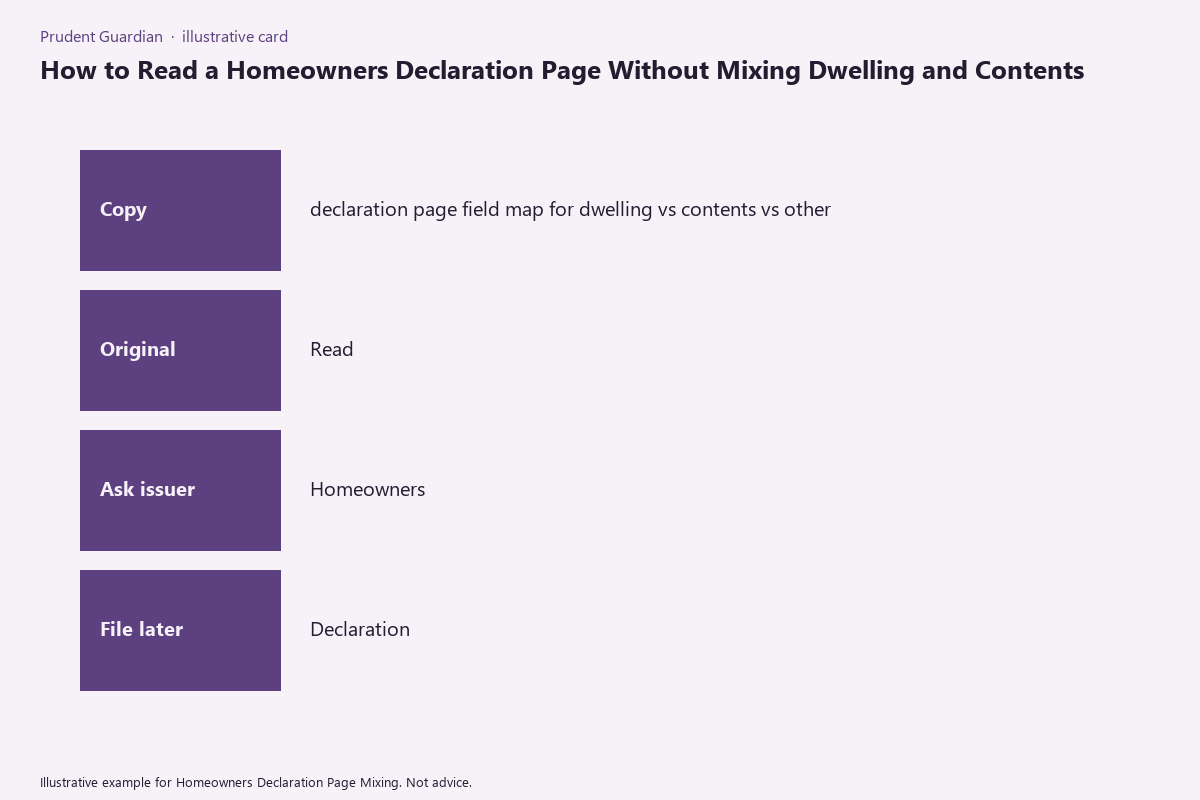
Contents coverage section header label sorting checklist
Contents, also called personal property, is almost always listed under Coverage C on standard policies, directly below Coverage B (other structures). Use this checklist to confirm you are sorting contents fields correctly and not mixing them with dwelling or other structures fields:
☐ Locate the Coverage C label, printed 1-2 lines below Coverage B in the core coverage limits block
☐ Confirm the header explicitly includes the phrase “Personal Property” or “Contents” to avoid mixing with Coverage A or B
☐ Verify the limit listed to the right falls between 50-70% of your Coverage A limit, which is the standard default for most carriers, though you can adjust this limit up or down based on your personal property value
☐ Cross-reference the deductible line directly below the Coverage C limit to confirm if it is the same as your dwelling deductible, or a separate lower deductible for personal property claims
☐ Check for indented endorsements listed under the Coverage C header, such as scheduled personal property for high-value items like jewelry or art, which are additional limits separate from the base contents coverage
☐ Confirm no other structures or dwelling line items are nested under the Coverage C header, which can happen on poorly formatted digital dec pages issued by smaller carriers
☐ Note the off-premises coverage percentage listed below the base contents limit, usually 10% of the total Coverage C limit, which applies to personal property lost or damaged outside your home, like luggage on a vacation or a laptop stolen from your car
All personal property owned by you or household members, on or off your property, falls under contents coverage, including furniture, clothing, portable electronics, non-built-in appliances, and sports equipment.
Standalone field map legend for cross-category value comparison
Use this standardized field map to quickly cross-reference coverage codes, categories, and coverage scope across your entire dec page, regardless of your carrier’s custom labeling:
| Standard Coverage Code | Category | Common Label Text | What It Covers | Sample Line Item Exclusions |
|---|---|---|---|---|
| Coverage A | Dwelling | Dwelling, Residential Structure, Main Home | Permanent attached home structure, built-in appliances, foundation, roofing, attached decks, permanent cabinetry, wall-to-wall carpeting, built-in light fixtures | Portable furniture, clothing, freestanding window AC units, detached sheds, fence, tenant property |
| Coverage B | Other Structures | Detached Structures, Other Private Structures | Freestanding structures on your property, including detached garages, sheds, fences, pool houses, backyard gazebos, standalone solar panel arrays | Any structure attached to the main home, personal property stored inside the detached structure (that falls under Coverage C) |
| Coverage C | Contents | Personal Property, Contents, Personal Belongings | All freestanding personal property owned by you or household members, on or off your property, including furniture, clothing, portable electronics, non-built-in appliances, jewelry (up to stated sublimit), sports equipment | Permanent built-in fixtures, home structure, detached structures, property owned by non-household tenants |
| Coverage D | Loss of Use | Additional Living Expenses, Loss of Use | Temporary housing, meal costs, and other extra living expenses if your home is uninhabitable after a covered loss | Regular monthly bills you would pay even if displaced, like car payments, student loans, or standard grocery costs |
If your carrier uses non-standard coverage codes that do not align with the NAIC format, cross-reference the label text with the full policy definitions section at the back of your policy packet to confirm category alignment.
Physical policy folder annotation tips for future reference
Taking 10 minutes to annotate your printed dec page and policy folder will eliminate confusion during a claim or policy update, when you may be stressed and short on time. First, print a physical copy of your dec page every time you renew or update your policy, even if you prefer to store digital copies, as physical copies are easier to access during power outages or internet disruptions after a loss. Use three different colored highlighters to color-code each core coverage category: yellow for all dwelling (Coverage A) fields, blue for all contents (Coverage C) fields, and green for all other structures (Coverage B) fields. Next, write the corresponding standard coverage code and category next to any custom label your carrier uses, for example, if your carrier labels Coverage A “Residential Premises Structure”, write “Dwelling / Coverage A” next to it in the margin. Staple a printed copy of the field map legend above to the inside front cover of your policy folder, so you can reference it quickly without navigating digital files. If you have endorsements that adjust your dwelling or contents limits, circle those and write a short note explaining the change, so you don’t confuse the base limit with the extended limit. For example, if you added a $50,000 ordinance or law endorsement to your dwelling coverage, write “+$50k ordnance/law” next to the Coverage A limit. Finally, write the date of any policy change next to your annotation, so you can track updates to your coverage limits over time. If you are unsure about how to categorize any line item on your dec page, reach out to your licensed agent for clarification before filing a claim.
Pull your most recent homeowners declaration page this week, use the field map above to label each coverage category in the margin, and confirm your dwelling and contents limits align with your current home rebuild cost and personal property replacement value.