
Educational overview only. Prudent Guardian (inspirecodingedu.com) is not an insurance company, broker, law firm, or registered investment adviser, and does not provide personalized insurance, investment, tax, medical, or legal advice. Verify details with licensed professionals and official issuers.
Correctly labeled banker’s boxes for claim files cut down on document retrieval time and reduce the risk of lost evidence during claim review or audit processes. Mislabeled boxes can lead to delayed claim determinations, missed appeal deadlines, or gaps in required documentation that can negatively impact your claim outcome. A consistent, standardized labeling system ensures all stakeholders, from claims adjusters to administrative support, can locate needed records without sorting through unmarked containers. Prudent Guardian offers this educational guidance to help households organize their claim paperwork clearly, with no binding impact on coverage, claim results, or legal proceedings.
Banker’s Box Primary Label Placement and Content Rules
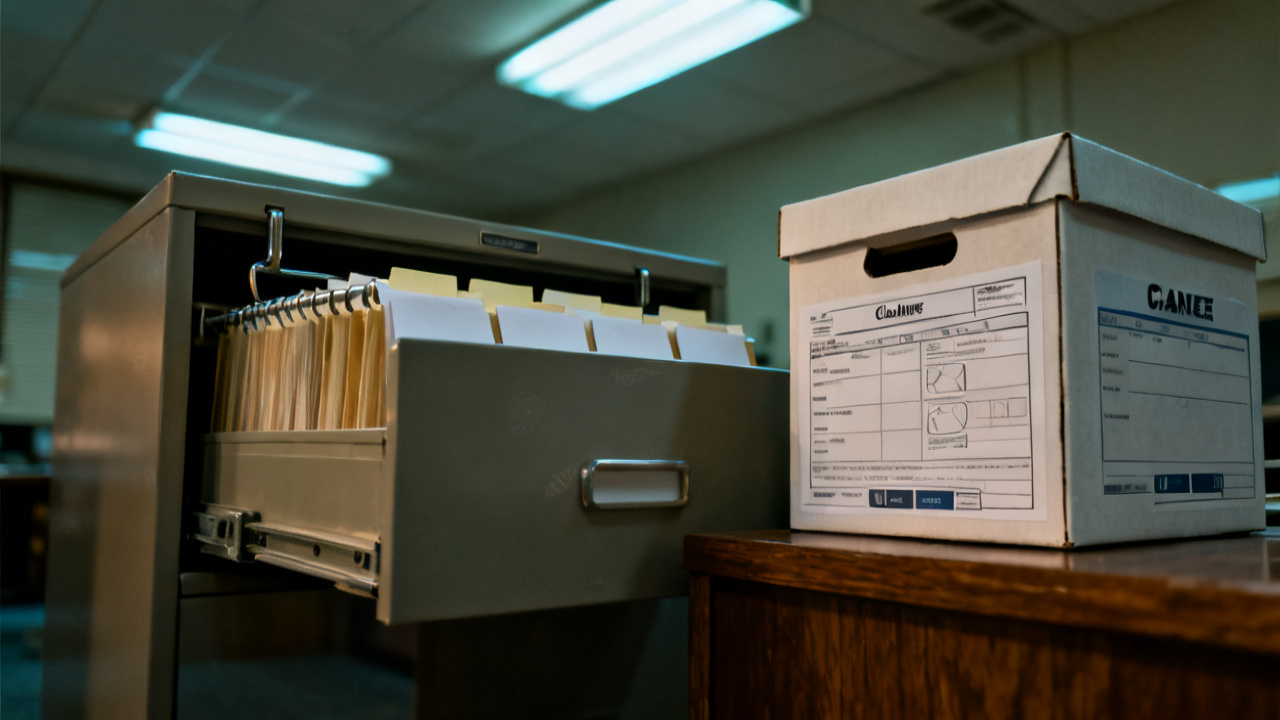
Use waterproof, smudge-resistant permanent adhesive labels for all box marking, as handwritten sticky notes or paper labels taped on with standard masking tape will fall off during storage, transport, or handling. Place one primary label on the front rigid panel of the box (not the foldable lid flap) 2 inches below the top edge, centered, so it is fully visible when boxes are stacked 4-high on standard 72-inch storage shelves. Place a second duplicate label on the narrow outward-facing top edge of the lid, so you can scan for specific boxes without pulling containers off the shelf. Avoid placing labels over the box’s perforated opening, as tearing the perforation to access contents will destroy the label. If you are storing boxes in a shared space or off-site storage facility, add a contact phone number (a non-work number you check regularly) to the corner of the label so storage staff can reach you if a box is misplaced. Never write your full Social Security number, credit card information, or full bank account numbers on the exterior label, as this poses an identity theft risk; use only the last 4 digits of an SSN if required for identification, and place that detail in small print in the bottom corner of the label only if necessary.
Banker’s Box Claim File Labeling Pre-Print Checklist
- [ ] Waterproof, smudge-resistant label stock used for all label copies
- [ ] Primary label affixed to front rigid panel (not lid flap) 2 inches below top edge
- [ ] Secondary duplicate label affixed to outward-facing top lid edge for shelf scanning
- [ ] Policyholder full legal name printed clearly (no nicknames)
- [ ] Full policy number listed, matching carrier-issued policy documents
- [ ] Carrier-assigned unique claim ID printed exactly as it appears on claim acknowledgement letters
- [ ] Box sequence number listed as “Box X of Y” where Y is total number of boxes for this claim
- [ ] No abbreviations for core policy/claim identifiers unless specified by your carrier
- [ ] All handwritten additions (if used) are in black permanent marker, all caps, 12pt or larger font size
- [ ] No sensitive personal information (full SSN, full bank account numbers) visible on exterior labels
Claim File Folder Identifier Coding for Box Labels
Every folder in your claim file should have a unique identifier, usually a 3-digit number plus a 3-letter category code, e.g., 001-MED for medical records, 002-COR for correspondence. On the box label, list the first and last folder ID included in the box, so you know exactly what is inside without opening it. For example, if a box holds folders 003 through 017, list “Folder Range: 003-COR to 017-APP” on the primary label, below the core claim information. If the box only holds one type of folder, note that, e.g., “All Folders: MED (Medical Records)”. If you use color-coded folders, note the color on the label for quick verification: e.g., “Folder Color: Blue (Medical Bills)”. If your claim spans multiple policy years or multiple related claims (for example, a health claim paired with a disability insurance claim for the same incident), add a 1-letter prefix to your folder identifiers to denote which claim or policy year the folder applies to, e.g., H-001 for health claim folders, D-001 for disability claim folders. List that prefix clearly on the box label so reviewers can immediately distinguish between related claim sets stored in the same stack of boxes. Cross-verify the folder range listed on the box with the contents before sealing the box, and mark the matching checklist item to avoid misfiling. Illustrative example: if your claim has 42 total folders spread across 3 boxes, box 1 would have folder range 001 to 014, box 2 015 to 028, box 3 029 to 042, each listed clearly on the respective box labels.
Claim Form Type Abbreviation Standards for Box Labels
Abbreviations are permitted for form and folder categories on box labels, but must be consistent across all boxes for the same claim, and easily decodable by any third party reviewing the file. Create a standard abbreviation key for all form types used in your claim, keep a printed copy of the key in the first box of the claim set, and save a digital copy to your cloud storage so you can reference it if you need to access records months or years after packing. Widely recognized 3-letter all caps abbreviations for common claim form types include: MED for medical records, COR for general correspondence, APP for appeal filings, BIL for itemized bills, POL for policy documents, ACK for carrier acknowledgement letters, EST for estimate of damages, REC for payment receipts, WIT for witness statements, PHOT for photographic evidence. Never use abbreviations for core identifiers including claim number, policy number, or policyholder name, as this can lead to misclassification of the entire box. If you are submitting boxes to a carrier or third-party administrator for review, confirm their accepted abbreviation list before printing labels, as some organizations have standardized form codes they require for all submitted documentation. Avoid using lowercase letters or special characters in abbreviations, as these can be misread by staff scanning labels for specific form types. Illustrative example: if a box holds only appeal forms and carrier acknowledgement letters, you would list “Form Types: APP, ACK” on the primary label below the folder range.
Claim Resolution Schedule Date Listing on Box Labels
Include 3 core date fields on every box label to support timeline tracking for your claim: the date the box was packed, the earliest and latest date of documents contained in the box, and any time-sensitive deadlines associated with the contents of the box. Use MM/DD/YYYY date formatting consistently to avoid confusion between month and day values, which can lead to missed deadlines. If your claim is subject to a statute of limitations or formal appeal timeline, include that date on the label of every box in the claim set, printed in bold font in the top right corner, so you can quickly identify all boxes associated with time-sensitive action items. If a box contains only documents related to a specific milestone, such as a mandatory independent medical exam, note that milestone and its date on the label, e.g., “Milestone: Independent Medical Exam, 07/09/2024”. This eliminates the need to open multiple boxes to locate records tied to a specific claim event. Illustrative example: a box holding records from January 2023 through March 2023 packed on June 12, 2024 would list “Pack Date: 06/12/2024 | Doc Date Range: 01/02/2023 to 03/28/2023” on the primary label.
Correspondence Letter Batch Note Requirements for Box Labels
If a box contains grouped batches of correspondence, add high-level batch details to the label to avoid opening the box to locate specific mail pieces. Group correspondence batches by sender or recipient: carrier correspondence, healthcare provider correspondence, legal representative correspondence, or your own outgoing correspondence. For each batch included in the box, list the sender/recipient type, the date range of the batch, and the batch ID if you have assigned unique identifiers to correspondence sets. If a box contains certified mail correspondence with tracking numbers, note the number of certified mail pieces in the batch on the label, e.g., “Correspondence Batch: Outgoing Certified, 5 pieces, Tracking ID range: 1Z999AA10123456784 to 1Z999AA10123456788”. This lets you confirm all certified mail pieces are accounted for without opening the box if you need to verify delivery status for an appeal. If any correspondence in the box requires follow-up, add a brief note of the follow-up deadline, e.g., “Follow-Up Note: Batch COR-003 requires response by 05/21/2024”. Never include sensitive details of correspondence (medical diagnoses, settlement offers, financial details) on the exterior label, to protect your privacy and claim confidentiality. If you have questions about what documentation you are required to submit for your claim, reach out to your assigned claims adjuster, policy issuer, or licensed legal or insurance professional for guidance tailored to your specific situation.
Your next action is to pull your most recent claim acknowledgement letter to confirm your exact claim ID and policy number before printing your first set of box labels.