Educational overview only. Prudent Guardian (inspirecodingedu.com) is not an insurance company, broker, law firm, or registered investment adviser, and does not provide personalized insurance, investment, tax, medical, or legal advice. Verify details with licensed professionals and official issuers.
Submitting a request for an official clerk-stamped copy requires presenting prefilled documentation and following the posted process steps for the specific clerk’s office you are working with. These copies hold formal legal validity for use in mortgage closings, insurance claims, name change filings, and property record updates, so adhering to office requirements reduces the risk of delayed or rejected requests. Prudent Guardian provides this educational guidance to help you navigate the process efficiently, and note that this resource is not legal or official office policy, so always confirm specific requirements directly with your local clerk’s office or a licensed professional if you have unique circumstance-specific questions.
Complete your clerk-stamped copy request card
This card is the primary sorting document for clerk’s office staff, so completing it accurately cuts down on processing time and reduces the risk of your request being misrouted. You can pick up a blank card at the clerk’s office front desk, or download a fillable version from your county or municipal government website 24 hours before your visit to skip filling it out while waiting in line. Double-check all fields for typos, especially case numbers and document dates, as mismatched information can result in your request being set aside for additional review, adding multiple business days to your wait time. Use the table below to complete your request card correctly:
| Field Name | Required Entry | Verification Check (mark when complete) |
|---|---|---|
| Requestor Full Legal Name | No nicknames or abbreviations, matches government-issued photo ID | ☐ |
| Requestor Contact Details | Current mailing address, working phone number, and email address (if available for status updates) | ☐ |
| Document Type Requested | Specific category (e.g. county property deed, small claims court filing, birth certificate, marriage license) | ☐ |
| Document Identifiers | Exact filing date (if known), associated case/file/parcel number (if known) | ☐ |
| Number of Stamped Copies | Exact count needed, confirm per-copy fees with the office ahead of time to avoid overpaying | ☐ |
| Reason for Request | Brief official purpose (e.g. mortgage underwriting, insurance claim verification, name change processing) | ☐ |
| Third-Party Authorization (if applicable) | If requesting on behalf of another person, note your relationship to the named document holder | ☐ |
| Requestor Signature & Date | Handwritten signature for in-person requests, digital signature for mailed/online submissions | ☐ |
Illustrative example: If you are requesting a stamped copy of a 2021 small claims court filing, you will need to list the exact case number assigned to your filing to avoid the clerk having to search hundreds of unrelated filings to locate your document.
Attach your supporting official request form
Most clerk’s offices require a secondary, longer official request form for stamped copies, separate from the short request card, to confirm you are authorized to access the requested document. For most public records, you will need to attach a black and white copy of your valid, unexpired government-issued photo ID (driver’s license, state ID card, or passport) to the form. If you are requesting the document on behalf of a family member, legal client, or other third party, you will also need to attach a signed, dated authorization letter from the named document holder, plus any required proof of representation documentation. Staple the completed supporting form and ID copy directly to the back of your request card to keep all materials grouped together for the processing clerk. If you are submitting your request via mail, include a self-addressed stamped envelope with sufficient postage for the number of copies you are requesting, as unstamped or under-stamped envelopes will result in your copies being held at the office or returned to sender unprocessed.
Place all materials in a labeled manila folder
Loose papers are easily misplaced or misrouted in high-volume clerk’s offices, so using a standard letter-sized manila folder keeps your request organized and easy for staff to locate during processing. Write the following information clearly in bold print on the front of the folder: your full legal name in the top left corner, the document case/file number in the top right corner, and the exact document type and number of stamped copies requested in the center of the folder. If you are dropping off your request in person, wait for the front desk clerk to confirm they have logged your request into their system before leaving the office, and ask for a printed receipt or unique request tracking number if available for future follow-up. If you are mailing your request, print the clerk’s office full physical mailing address clearly on the front of the outer envelope, and add a line reading “ATTN: Stamped Copy Requests” below the address to help mailroom staff route your folder to the correct processing team immediately.
Mark your personal calendar for pickup timing
Processing times for stamped copies vary widely between offices, from same-day service for common vital records to 10+ business days for older court filings, so always ask the clerk processing your request for an exact estimated ready date when you submit your materials. Mark that estimated ready date on your personal calendar, plus a follow-up date 2 business days after that date to contact the office if you have not received a notification that your copies are ready for pickup or have been mailed. Illustrative example: If the clerk tells you your request will take 4 business days to process, mark day 4 as your scheduled pickup date, and day 6 as your follow-up date to call the office if you have not heard any updates. If you requested mailed copies, add 3 additional business days for standard postal delivery before reaching out to follow up, as postal delays are common and do not indicate a problem with your request. Avoid visiting the office to check on the status of your request before the estimated ready date, as unscheduled status checks pull staff away from processing requests, increasing wait times for all requesters.
Store your received stamped copy in a fireproof box
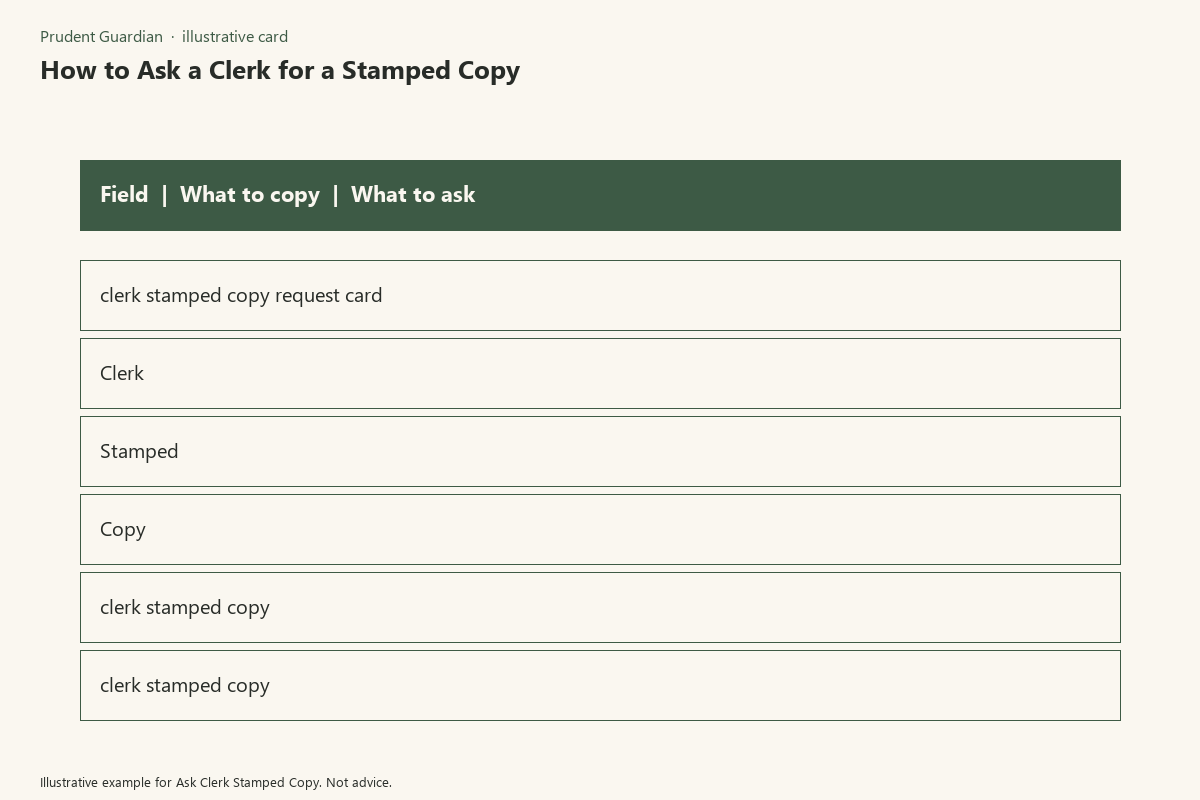
Clerk-stamped copies are considered official legal documents, so storing them in a secure, temperature-controlled location prevents damage from water, fire, or loss that would require you to submit a new request and pay associated fees a second time. If you need to submit a stamped copy to a third party such as a mortgage lender, insurance provider, or state government office, make a plain paper copy and a password-protected digital scan of the stamped document for your own personal records before sending the original stamped copy to the third party. Keep the digital scan stored in a secure cloud folder so you can easily reference the information if you need to request additional stamped copies in the future. Prudent Guardian recommends consulting with a licensed legal or financial professional if you have questions about how to use your stamped copy for official legal or financial transactions, as this guidance is not legal advice and cannot bind any official transaction outcome.
Before your next visit to the clerk’s office, print and fill out your request card using the table provided above to reduce in-person wait time and lower the risk of processing delays.