Educational overview only. Prudent Guardian (inspirecodingedu.com) is not an insurance company, broker, law firm, or registered investment adviser, and does not provide personalized insurance, investment, tax, medical, or legal advice. Verify details with licensed professionals and official issuers.
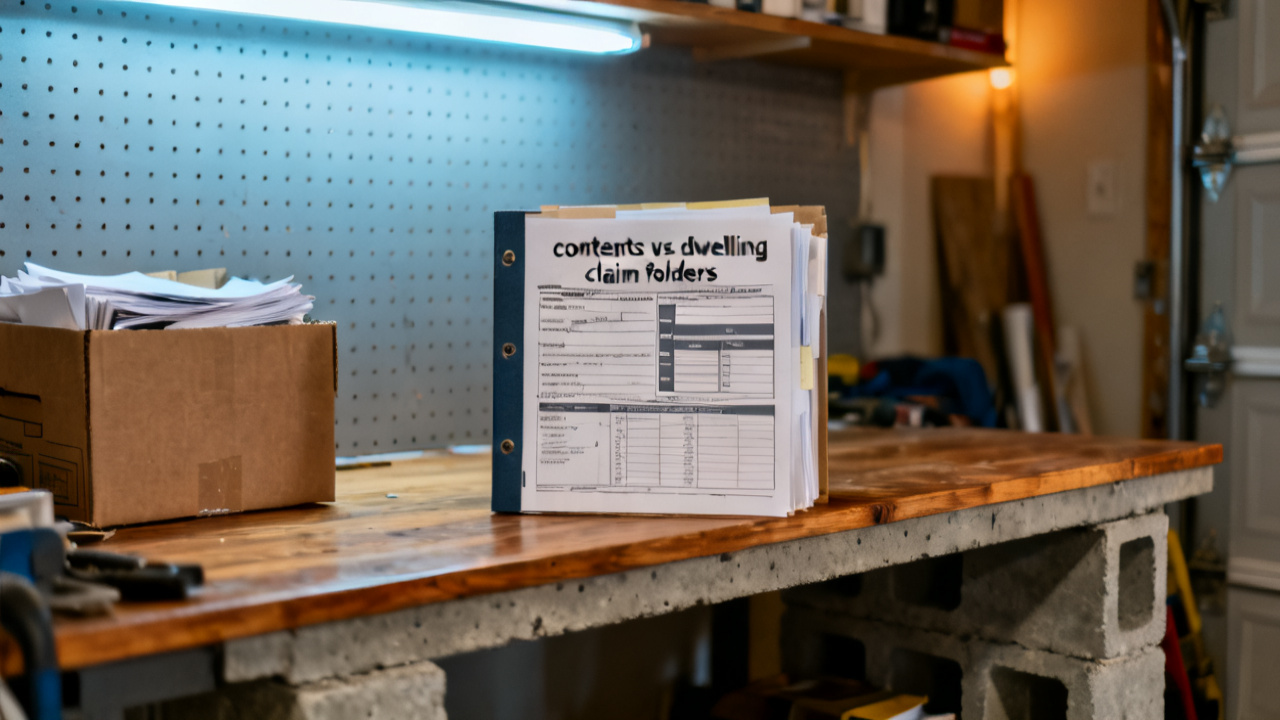
This contents vs dwelling claim-file split table standardizes documentation sorting for policyholders submitting separate home insurance claims for structural property damage and personal property loss after a covered event. Mixing dwelling and contents documentation in a single submission is one of the most frequently cited causes of delayed claim payouts, per public carrier processing guidelines, as adjusters must re-sort materials manually before reviewing eligibility. This framework works for both homeowners filing full property claims and renters filing separate structural damage (if applicable under their lease terms) and personal property claims, and Prudent Guardian offers this education as a general reference only, not a substitute for guidance from your insurance carrier or licensed claim professional. No information on this page binds coverage, claim approval, or settlement terms.
Prudent Guardian editors

| Document Category | Dwelling Claim Folder | Contents Claim Folder | Notes |
|---|---|---|---|
| Policy documents | Excerpt with dwelling coverage limit, deductible, and relevant covered perils only | Excerpt with personal property coverage limit, deductible, and relevant covered perils only | Do not include full policy packet in either to reduce processing time |
| Structural repair estimates | Include all licensed, bonded contractor bids for structural work | Exclude | Structural work includes foundation, roofing, framing, and built-in appliances permanently affixed to the property |
| Personal property proof | Exclude | Include receipts, photos, appraisals, and replacement cost estimates for all lost/damaged items | Items over $1,000 may require separate proof of ownership forms per carrier rules |
| Emergency work receipts | Include receipts for structural emergency work (tarping roof, boarding windows, flood water pumping) | Include receipts for emergency personal property remediation (dry cleaning of clothing, data recovery for electronics, furniture decontamination) | Mark each receipt explicitly with which claim it applies to before submission |
| Adjuster communications | Include all messages related to structural damage assessment and repair | Include all messages related to personal property valuation and replacement | File communications separately to avoid cross-contamination of claim records |
Dwelling claim folder included documentation list
The dwelling claim covers fixed, structural components of your property, so all documentation in this folder must relate exclusively to those components, with no personal property materials included. Required items for the folder include: an excerpt of your insurance policy declaration page showing only your dwelling coverage details, timestamped pre-event structural documentation (including prior inspection reports and photos of your roof, foundation, and built-in appliances taken within 12 months of the event, if available), timestamped post-event visual documentation sorted by area of the property with clear scale markers (e.g., a ruler next to a foundation crack, a coin next to a shingle tear) to help adjusters assess damage severity, all written bids from licensed contractors for structural repair work including labor and material cost breakdowns and copies of each contractor’s state license, receipts for any emergency structural work completed in the first 72 hours after the event marked explicitly as dwelling-related expenses, copies of any permits pulled for structural work and notifications sent to your mortgage lender about the damage if required by your mortgage terms, and all written communication with your insurance carrier related to structural damage assessment, including adjuster visit confirmations and status update emails.
Contents claim form required entry fields
Most carriers require a standardized line-item contents claim form to process personal property loss, and incomplete fields will result in automatic resubmission requests that can add 10 or more business days to your processing timeline. All entries must match supporting documentation you submit with the form to avoid eligibility questions. Mandatory fields include: full policy number, policyholder full name, property address, and covered event date typed clearly at the top of every page of the form to avoid misfiling, a line-item entry for every damaged, destroyed, or stolen personal property item with a specific description (e.g., “13-inch 2022 MacBook Pro, M2 chip, silver” instead of “laptop”) to reduce valuation disputes, original purchase date, original purchase cost, and place of purchase for each item (if you do not have a receipt, include a screenshot of the current retail price for the same or equivalent item from a major retailer), damage severity rating for each item marked as minor (repairable for less than 50% of replacement cost), major (repairable for more than 50% of replacement cost), or total loss (cannot be repaired), current replacement cost estimate for each item aligned with your policy’s coverage terms (if you have actual cash value coverage, you will also need to include a depreciation calculation based on the item’s age and pre-event condition), and a signed and dated attestation at the end of the form confirming all entries are true and accurate to the best of your knowledge, as false entries can result in claim denial or policy cancellation.
Claim separation schedule documentation cutoff timelines
All timelines are set by your individual carrier and state insurance regulations, so you must confirm exact cutoffs in your policy documents or by contacting your carrier’s claim department directly. Illustrative example: Standard processing timelines for separated claims follow this general schedule, which aligns with most state insurance requirements: 3 business days after the covered event, submit initial notice of both dwelling and contents claims to your carrier, and request separate claim numbers for each to make tracking easier. 10 business days after the covered event, submit your full dwelling claim folder, either via digital upload to your carrier’s portal, certified mail with return receipt, or in-person delivery to your local carrier office, and save a confirmation of receipt for your records. 15 business days after the covered event, submit your completed contents claim form and all supporting personal property documentation, again saving proof of submission. 30 business days after the covered event, submit any supplemental documentation requested by your adjuster for either claim, including additional photos, contractor references, or proof of ownership for high-value items. 45 business days after the covered event, most carriers are required to provide a written decision on both claims within this window, per state regulations, though extensions may be granted if additional investigation is required. Missing any cutoff date can result in delayed processing or even claim denial, so mark all deadlines on a physical or digital calendar as soon as you receive them from your carrier.
Supporting proof letter filing order instructions
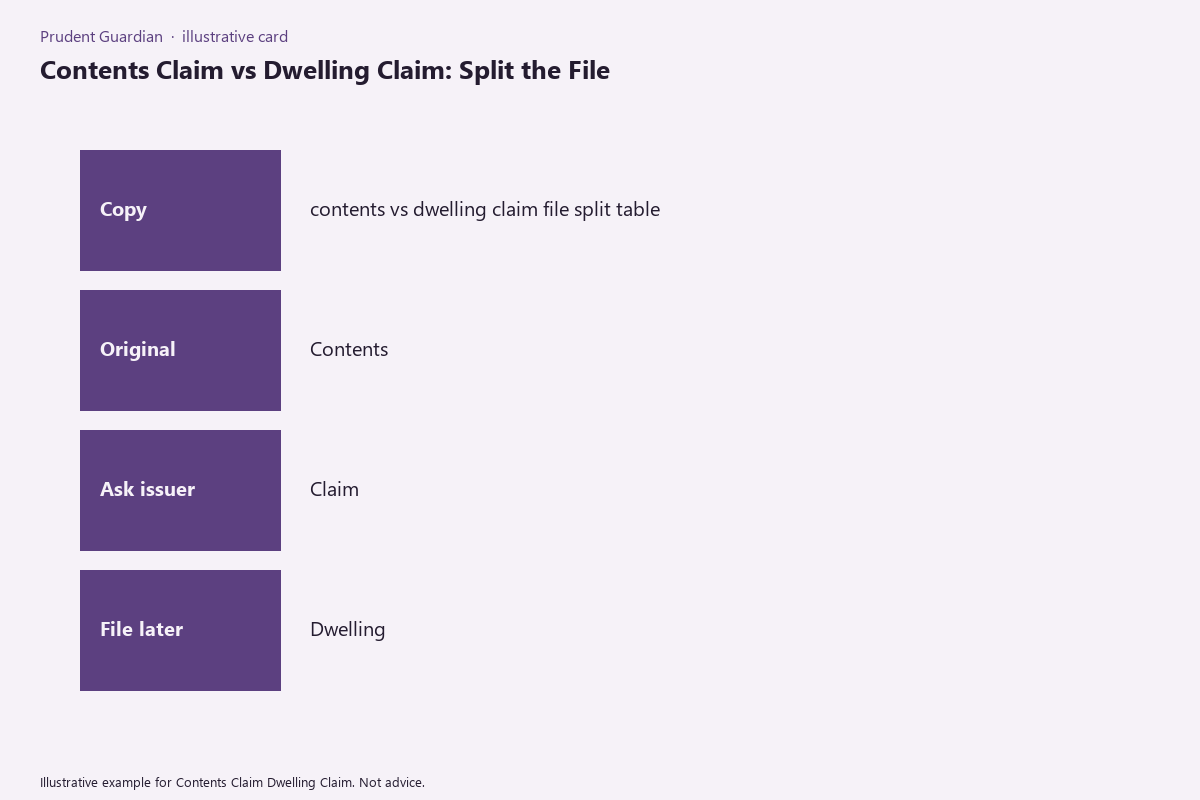
The order you arrange documentation in each claim packet directly impacts processing speed, as adjusters are trained to look for key documents first when reviewing a new claim. For dwelling claim packets, follow this exact order from top to bottom: 1. One-page cover letter explicitly marked “DWELLING CLAIM ONLY” at the top, with your full name, separate dwelling claim number, event date, contact phone number, and email, plus a 1-sentence summary of the total damage amount you are claiming for structural repairs. 2. Adjuster assignment confirmation, if you have already been assigned a specific adjuster for your dwelling claim, including their full name, employee ID, and contact information. 3. Contractor repair bids, sorted from lowest to highest total cost, with each bid stamped with the contractor’s license number and contact information. 4. Visual documentation, sorted chronologically from pre-event to post-event, with all photos labeled clearly with the area of the property they depict. 5. Emergency work receipts and permit copies, sorted by date of service. 6. Carrier communication records, sorted from most recent to oldest. For contents claim packets, follow this order: 1. One-page cover letter explicitly marked “CONTENTS CLAIM ONLY” at the top, with your separate contents claim number, full identifying information, and 1-sentence summary of the total personal property loss amount you are claiming. 2. Completed, signed contents claim form, with all line items filled out as required. 3. Proof of ownership documentation, sorted by item value from highest to lowest, so high-value items are reviewed first. 4. Any police reports, fire marshal reports, or other official incident reports related to personal property loss or theft. 5. Carrier communication records related specifically to your contents claim, sorted from most recent to oldest. Always make two full copies of each completed packet before submission: one for your personal records, and one to provide to a licensed public adjuster if you choose to hire one for claim support.
Archival document box storage labeling requirements
You must keep all original copies of claim documentation for a minimum of 3 years after your final claim settlement is paid, to resolve any post-settlement disputes, tax questions, or future claim eligibility concerns. When storing your physical copies in a document box, follow these labeling requirements to ensure you can locate materials quickly if needed: Print your full policy number, covered event date, and event type (e.g., “2024-04-22 Tornado Damage”) in large, bold font on the top and all four sides of the box. Add separate labels on two sides of the box: one reading “DWELLING CLAIM ORIGINAL DOCUMENTS” and one reading “CONTENTS CLAIM ORIGINAL DOCUMENTS”, with the submission date for each claim listed under the respective label. Add your full name, current contact phone number, and email address on one side of the box, in case the box is misplaced during a move or storage transfer. If you were assigned separate adjusters for each claim, list each adjuster’s name, employee ID, and contact information under the corresponding claim label. Print the phrase “DO NOT DISCARD UNTIL 3 YEARS AFTER FINAL SETTLEMENT” in all caps, bold font, on the top of the box, with the date of your final settlement filled in once you receive your final payout. Store the box in a waterproof, fireproof safe or offsite secure storage facility if your home was damaged in the covered event, to avoid losing your original copies in a subsequent incident.
The next immediate action you can take is to gather all documentation you have collected so far related to your recent covered event, and sort them into two separate piles using the split table above to identify which materials belong to the dwelling claim and which belong to the contents claim.