Educational overview only. Prudent Guardian (inspirecodingedu.com) is not an insurance company, broker, law firm, or registered investment adviser, and does not provide personalized insurance, investment, tax, medical, or legal advice. Verify details with licensed professionals and official issuers.
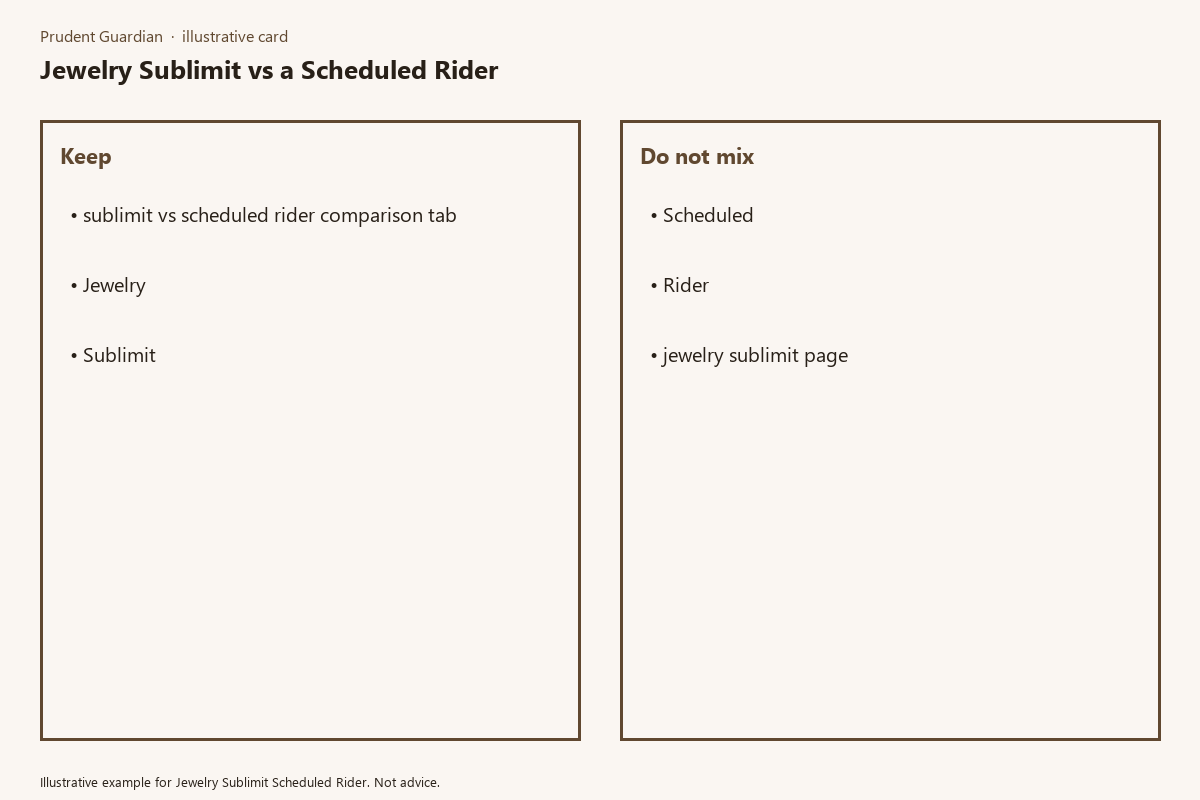
This side-by-side comparison table clarifies key distinctions between jewelry insurance sublimits and scheduled riders for standard U.S. household personal property policy paperwork. Most standard renters, homeowners, and condo policies include default jewelry coverage under the broader personal property protection section, but sublimits often cap payouts far below the value of high-cost pieces like engagement rings, heirloom necklaces, or luxury watches. The table below helps you cross-reference policy language against your own documents to avoid unexpected claim denials or underpayment, and all guidance is for educational use only from Prudent Guardian; coverage terms are always binding only per your official policy documents from your insurance carrier.
| Category | Standard Jewelry Sublimit | Scheduled Jewelry Rider |
|---|---|---|
| Payout Cap Structure | Fixed per-incident and per-item caps listed on the policy declaration page, apply to all jewelry claims regardless of total collection value | Per-item agreed value listed on the attached valuation schedule, no aggregate per-incident cap for covered losses |
| Covered Perils | Only named perils explicitly listed in the base policy (common examples: fire, smoke, home theft, vandalism) | Open perils coverage for all damage or loss except events explicitly excluded in the rider (common exclusions: intentional damage, intentional loss) |
| Deductible Applicability | Full base policy deductible applies to all jewelry claims paid under the sublimit | Often includes a $0 deductible or separate low deductible selected when the rider is added to the policy |
| Required Coverage Documentation | No pre-coverage documentation required; proof of ownership (receipt, photo, appraisal) only required at the time of a claim | Pre-coverage documentation required for all listed items, including a professional appraisal, clear photos of the piece, and proof of purchase if available |
| Claim Review Timeline | Extended review periods are common for claims near or exceeding sublimit caps, as carriers may request additional proof of value | Pre-approved agreed value reduces review time, with most valid claims processed 3 to 5 business days faster than sublimit claims |
| Common Exclusions | Accidental loss, damage from regular wear and tear, loose stone loss, damage from improper storage, off-premises theft caps | Rarely exclude accidental loss, wear and tear, or loose stone loss; exclusions are limited to events explicitly listed for each item on the valuation schedule |
Policy Declaration Form Jewelry Sublimit Entry Fields
Your policy declaration (declarations) page is the first 1 to 2 pages of your personal property policy packet that lists core coverage limits, deductibles, and covered perils for your household. Jewelry sublimits are almost always listed in a dedicated section labeled “Special Limits of Liability” or “Sublimited Personal Property Categories”, separate from the general personal property coverage limit that applies to most household belongings. The key entry fields to locate for jewelry coverage include the per-item payout cap, per-incident payout cap, and any modifiers that adjust coverage for events like off-premises theft or loss during travel. Always confirm that the sublimit values listed match the terms you agreed to when purchasing your policy, as administrative errors can lead to lower-than-expected coverage. Illustrative example: a standard decl page may list a $2,500 per-incident jewelry sublimit with a $1,500 per-item cap, and a 50% reduction in coverage for jewelry stolen more than 100 miles from your primary residence. If you cannot locate these entry fields on your decl page, reach out to your insurance carrier’s customer service team to request a written breakdown of your jewelry coverage limits.
Personal Property Folder Scheduled Rider Storage Guidelines
A scheduled jewelry rider is a formal add-on endorsement to your base personal property policy, so it requires separate storage alongside your core policy documents to ensure you can access it quickly during a claim. Use a dedicated, labeled personal property insurance folder stored either in a fireproof home safe or a password-protected cloud folder for your primary rider documents. Follow these storage guidelines to keep your records organized: 1) Keep the original signed rider endorsement directly next to your base policy decl page in your physical folder, 2) Save a scanned PDF copy of the rider and all associated documents in a cloud folder accessible to you and at least one trusted household member, 3) Paperclip printed copies of all appraisals, photos, and purchase receipts for scheduled items to the back of the physical rider document, 4) Update the folder annually during your policy renewal period, or whenever you add or remove a jewelry piece from your rider, 5) Cross-reference the rider’s effective and expiration dates with your base policy renewal date to avoid gaps in coverage when you switch policies or renew your existing plan.
Insurance Confirmation Letter Sublimit Limit Disclosures
Your insurance carrier will send a formal confirmation letter within 10 business days of purchasing a new policy or renewing an existing policy, which restates key coverage terms to confirm you agreed to the listed limits and exclusions. Always review this letter closely to verify your jewelry sublimit terms match the values listed on your decl page, as administrative errors during policy processing can lead to unplanned reductions in coverage. Look for three key disclosures related to jewelry sublimits: first, confirmation that the per-item and per-incident sublimit values match the terms you discussed with your agent, second, any fine print notes about sublimit reductions for specific high-risk events like theft from an unlocked vehicle or loss during international travel, third, any new exclusions added to jewelry coverage since your last renewal, such as exclusions for jewelry used for business or commercial purposes. Illustrative example: a renewal confirmation letter may note that the jewelry sublimit for items left in a rental vehicle is reduced to $500, even if your standard per-item sublimit is $1,500. If you spot a discrepancy between the confirmation letter and the terms you agreed to, contact your agent immediately to request a corrected document before the policy effective date.
Household Document Box Sublimit Rider Reference Copies
Your main household document box, where you store non-sensitive records like tax returns, property deeds, and birth certificate copies, should include reference copies of both your jewelry sublimit terms and scheduled rider to streamline the claim reporting process. These reference copies do not need to be full official documents, and you can redact sensitive information like your full policy number or coverage limits for other personal property categories if you wish. Include the following materials in your reference packet: 1) A printed excerpt of your decl page showing only the jewelry sublimit line items and associated coverage modifiers, 2) A one-page summary of your scheduled rider that lists each covered piece, its agreed value, and the rider’s effective and expiration dates, 3) a printed contact sheet with your insurance carrier’s 24/7 claim line number and your policy number for quick reference. Note that these reference copies are not binding for claim purposes, so you will still need to submit official signed documents from your primary policy folder when filing a formal claim, but they help you quickly confirm coverage limits when you first report a loss to your carrier.
Itemized Valuation Schedule Rider Coverage Specifications
The itemized valuation schedule is the core supporting document attached to your scheduled jewelry rider, which lists every covered piece and defines the exact coverage terms for each individual item. Review this schedule carefully when you first add a rider, and revisit it annually during your policy renewal to confirm all details are accurate. The key specifications to verify for each listed item include: 1) A full, detailed description of the piece, including carat weight for diamonds and gemstones, metal purity, brand and serial number for luxury watches, and any unique identifying marks like engravings, 2) The agreed upon payout value, which is the full amount you will receive for a total covered loss of the item, minus any applicable rider deductible, 3) A list of perils covered for that specific item, such as coverage for accidental damage during shipping or loss while traveling internationally, 4) Any applicable item-specific exclusions, such as an exclusion for damage to a vintage pearl necklace caused by exposure to harsh household chemicals. It is recommended that you have each scheduled piece reappraised every 3 to 5 years to account for changes in market value, and submit updated appraisals to your carrier to adjust the agreed value on the schedule, so you are not underpaid if the piece is lost or damaged. You can request to remove items from the schedule at any time if you sell, gift, or no longer own the piece, which may reduce your rider premium cost.
Pull your current personal property policy declaration page this week to locate your jewelry sublimit terms, and compare them to the total appraised value of your jewelry collection to determine if adding a scheduled rider is necessary.